


 For years, ranking high on Google was the key to online visibility. Now, AI assistants are quickly becoming the gateway for how people find information.
In fact, some marketers are already seeing double-digit drops in Google traffic even when their search rankings haven’t changed, as more users turn to AI answers instead.
Generative AI models like ChatGPT have skyrocketed in usage. OpenAI reported that the new ChatGPT web search feature hit over a billion searches in a single week. Surveys also show that millennials and Gen Z users have started using tools like ChatGPT instead of traditional search engines for product recommendations.
In short, consumers are forming new habits virtually overnight.
This shift has big implications for merchants. Visibility on a Google results page might not translate into clicks the way it used to.
For example, the rise of AI-powered search results and snippets has pushed the rate of no-click searches to nearly 69% on the web. That means users often get what they need from an AI-generated answer or summary without ever visiting a website.
In other words, some of the traffic that used to come from Google is now coming from AI assistants. This is a huge opportunity for those who prepare, and a potential setback for those who don’t adapt.
The bottom line: SEO isn’t “dead,” but it’s evolving.
It’s less about gaming algorithms for a top spot on a search page, and more about earning a spot as a trusted source that an AI will cite or recommend. Instead of optimizing solely for blue links, you’re now optimizing to be part of an AI-driven conversation with the shopper.
 Traditional SEO is about getting to the first page of search engine results.
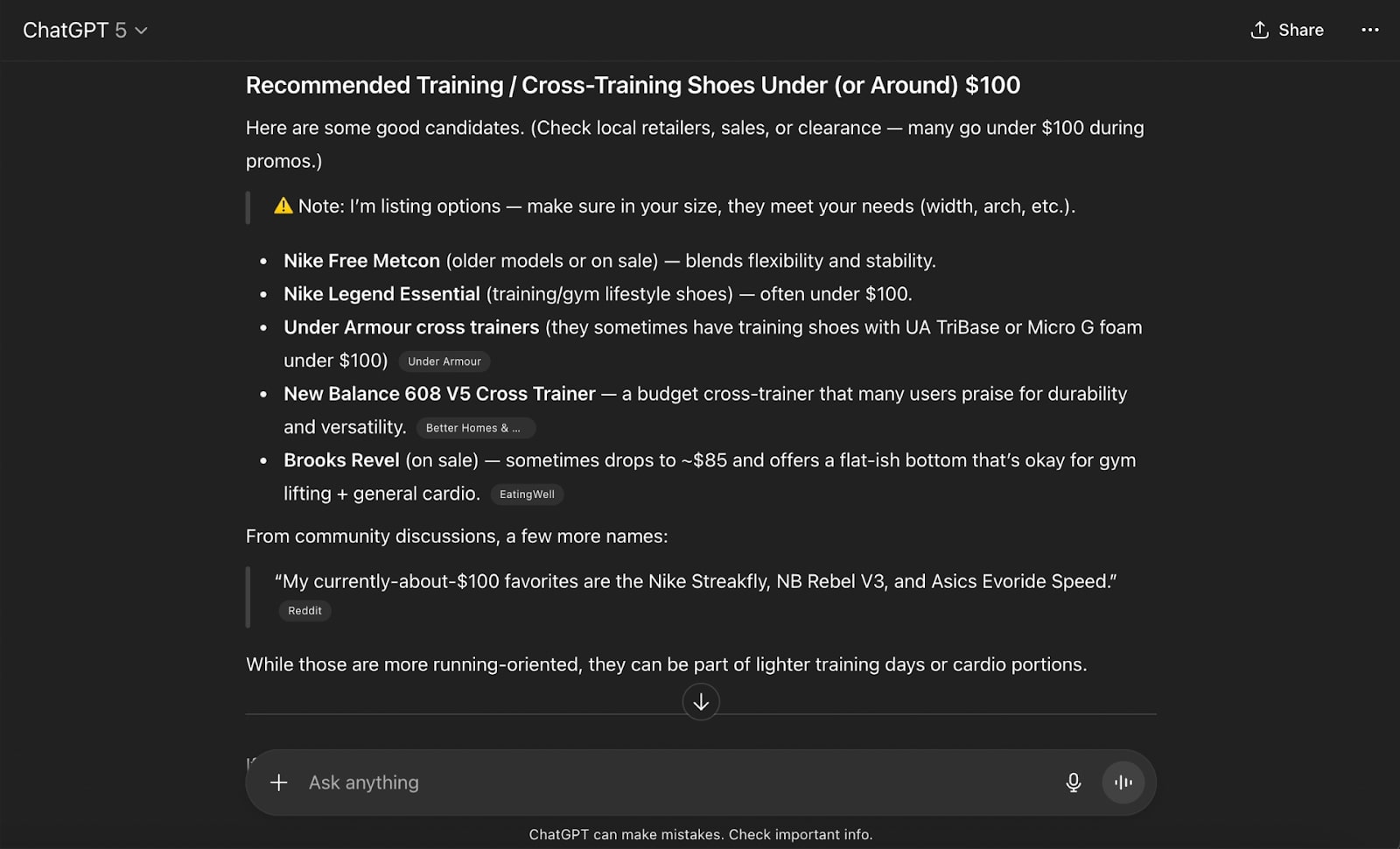
But AI chatbots don’t display 10 blue links, they give one synthesized answer (often with a couple of citations or suggestions). “Ranking” in an AI result means your content is selected by the AI as part of its answer.
This could be a direct citation (for example, Bing Chat might quote your blog post with a link), or it could be that the AI’s advice is influenced by information it learned from your content.
In practice, it’s about becoming the trusted source that the AI pulls in when responding to users’ questions.
It helps to understand how ChatGPT and similar models gather and present information:
- Training vs. Live Search: ChatGPT (and other LLMs) learn from vast training data. If your site’s content was part of that data, the model might “recall” facts or wording from it when asked a relevant question. Additionally, newer chat search modes perform live web searches and then summarize the results. In both cases, having high-quality, easily digestible content increases the chance the AI will use it.
- No Keyword-Stuffing: AI chatbots don’t hunt for exact-match keywords like a traditional search engine might. They look for patterns and comprehensive answers. In other words, they aren’t scanning for the one page with the most instances of “best print-on-demand T-shirt”; they’re trying to genuinely answer “What’s the best way to create a print-on-demand T-shirt business?” by combining knowledge from various sources. This means quality and relevance beat keyword tricks. The AI is looking for content that thoroughly addresses the question in natural language.
- Citations and Sources: Some AI search implementations (like Bing Chat, ChatGPT with browsing, or Google’s Search Generative Experience) will cite sources. If your content is cited, it can drive traffic. Importantly, there’s no paid placement here – you can’t buy your way into an AI answer. Any website or merchant can appear in a ChatGPT result since the AI picks results organically from what it finds. This levels the playing field and puts the focus squarely on content quality.
In essence, ranking in AI is about being the most informative, trustworthy piece of content on a given topic or question, so that the AI deems it worth including in its answer.
Instead of an SEO battle for first position, think of it as a race to become the most trusted assistant in your niche.
 Large language models have a kind of “checklist” for what makes content useful to them.
Many of these factors overlap with good traditional SEO practices, but there are some new twists.
Here’s what AI assistants tend to favor:
- Clear, Structured Information: Generative AI prefers content that is well-organized and easy to parse. This means your product descriptions, blog posts, and help pages should be formatted cleanly with headings, bullet points, and straightforward language. Dense or disorganized text is harder for the AI to interpret.
- Natural, Conversational Tone: Content written in a human, conversational tone tends to align well with how AI formulates answers. Think question-and-answer formats, explanatory paragraphs, or storytelling, i.e. content that reads like one person helpfully talking to another. Overly stiff or jargon-filled text might be ignored in favor of a source that sounds more relatable and clear.
- Authority and Accuracy: ChatGPT and other models try to provide correct information. They gravitate towards content that demonstrates expertise and backs up its claims. High-quality outbound links or references to data can signal that your content is well-researched (for example, citing a credible statistic about your industry). Additionally, if your brand or site is mentioned frequently in trusted contexts (news articles, reputable forums, etc.), the AI perceives you as more authoritative.
- Unique Insights and Perspectives: AI models have been trained on a lot of generic content. If you offer a fresh take or very niche knowledge, you’re providing something the AI might not find everywhere. Unique content can stand out in the AI’s “mind” and be more likely to appear in an answer. For a Shopify merchant, this could mean sharing your authentic story, niche product use-cases, or insider tips that only someone with your experience might know. That uniqueness can be a hook for an AI-generated answer.
- Consistent Branding and Naming: Interestingly, consistency in how you present your brand and products makes a difference. AI models notice if your product is referenced under slightly different names in different places (and it can confuse them). Ensure your product names, brand name, and key descriptions are consistent across your site and across the web.
- Up-to-Date Content: Fresh, up-to-date content can be favored in those cases. If ChatGPT’s browsing or Google’s AI is looking at web results, a recent blog post or very current product info could outrank stale content. Regularly update your site with new information (new blog articles, updated FAQs, fresh customer reviews). This not only helps traditional SEO but also ensures an AI search isn’t drawing from outdated info when it encounters your site.
In summary, LLMs prioritize clear, truthful, and comprehensive content that reads well and is consistently presented.
This isn’t so far from what Google has preached with its “helpful content” updates, it’s just that the way the content is extracted and delivered to users is changing.
Next, let’s look at what you can do to align with these priorities and boost your visibility.
 So, how can a Shopify merchant practically apply these insights?
Here are beginner-friendly steps to make your store more visible in ChatGPT, Bing Chat, Bard, and whatever AI search comes next.
These steps focus on optimizing your content and site for the new era of search, and we’ll also highlight how MyDesigns tools can help you implement them efficiently.
Allow AI to Crawl Your Site
First, ensure your store isn’t blocking AI crawlers. OpenAI’s ChatGPT, for example, uses a crawler to index content. By default, most Shopify stores are crawlable, but if you’ve ever tweaked your robots.txt, double-check that you’re not disallowing common AI user agents.
In short, don’t opt out of being indexed by these models if you want to appear in their results.
Write Conversational, Question-Friendly Product Descriptions
Rewrite your product titles and descriptions in a way that answers potential customer questions. Instead of a sparse description full of specs, provide context.
For example, a traditional description might say “Cotton T-shirt with custom print, unisex, sizes S-XL.” An AI-optimized description would add, “This unisex cotton T-shirt features a durable custom print. It’s comfortable for everyday wear – perfect for casual outings or even as a gym shirt. Available in sizes S-XL, it answers the call for a soft, breathable feel in all seasons.”
This way, if someone asks ChatGPT “What’s a good comfy t-shirt for daily wear?” your product has a better chance of fitting the answer. Use natural language and include the kinds of details a shopper cares about. You can also incorporate common customer questions into your descriptions (or create a small FAQ on your product page).
Crafting rich product descriptions is a breeze with Vision AI. It uses AI to generate SEO-friendly titles, tags, and descriptions for your listings. It’s one of MyDesigns’ most used features, and we’ve trained it to include relevant keywords in a natural way, so your content appeals to both search algorithms and conversational AI.
Organize and Structure Your Content Clearly
Make your content easy for an AI (and a human) to scan. This means using headings, short paragraphs, and bullet points for key features or specs. If you sell a gadget, for example, list the top features in bullet points (“- Battery life: 10 hours; – Compatibility: iOS and Android; …”).
Structured data helps too. Consider adding FAQ sections or even using Shopify apps to include schema markup for product details and FAQs. The easier it is to parse your content, the more likely an AI will extract the right information from it.
Focus on Long-Tail and Semantic Keywords
 In the AI era, it’s not about single keywords, but about covering clusters of related questions and phrases. Think about the various ways someone might ask about your product. If you sell handmade soy candles, a user might ask, “What are the best non-toxic candles for living room ambiance?”
Ensure your content touches on “non-toxic,” “soy,” “long-burning,” “for living room,” “relaxing ambiance,” etc., where relevant. This doesn’t mean stuffing them all unnaturally, but weaving them into your narrative.
For example: “Our soy candles are a non-toxic choice that’s perfect for creating a relaxing living room ambiance. With a long burn time of 40 hours, they’ll set the mood for many cozy evenings.” Covering these bases increases your chances of matching an AI’s understanding of the topic.
Keep Information Fresh and Consistent Across Channels
If you’re selling on Shopify, Etsy, Amazon, etc., make sure all platforms have up-to-date and matching information. AI models crawl many sources. If your Shopify site says “item is eco-friendly bamboo” but your Etsy is outdated and doesn’t mention it, you’re weakening the signal.
Consistency, as mentioned, is key for brand recognition in AI. Update your listings regularly, even if it’s minor tweaks, to signal that your content is active.
MyDesigns was built to simplify multi-channel selling. With its Shops and Integrations, you can sync your product listings across Etsy, Shopify, WooCommerce, Amazon, and more. Use the platform’s bulk publish feature to push changes to all marketplaces at once.
Leverage High-Quality Visuals with Descriptive Alt Text
Visuals matter in two ways. First, if an AI search result (like ChatGPT’s product browsing) displays images, you want yours to shine and look professional.
Second, AI algorithms can also “read” image metadata. Having descriptive file names and alt text on your images provides another layer of information (for both AI and accessibility for humans). Make sure your images have meaningful names (e.g., yellow-candle-soy.jpg instead of IMG_1234.jpg) and alt text like “Handmade soy candle in glass jar on a coffee table.” This reinforces to AI what’s in the image and the context, which can help it tie into an answer about, say, cozy home décor recommendations.
Creating and managing great product photos is easier with MyDesigns. The platform’s Canvas tool is a drag-and-drop design editor where you can create on-brand images, add text overlays, or design infographics for your listings.
You can also use MyDesigns’ mockup and image editing features (like background removal and image upscaling) to make sure every product photo is polished. Once you have top-notch images, MyDesigns lets you bulk upload and attach them to listings on all platforms, saving you the tedium of updating each site.
Provide Valuable Content Beyond Product Pages
Think about creating content that positions you as an expert or a go-to resource in your niche. This could be a blog on your Shopify store, a guides section, or even detailed product manuals. AI assistants love to pull from explanatory and informational content.
For example, if you run a print-on-demand T-shirt shop, a blog post titled “10 Tips for Designing a T-Shirt That Sells” or “How to Choose the Right Fabric for Your Custom T-Shirt” could get picked up by an AI answering a user question on those topics.
Encourage Engagement and Reviews
 Encourage buyers to leave reviews and ask questions on your product pages. User-generated content like Q&As and reviews not only builds trust for other shoppers, but it also expands the informational footprint of your pages.
A detailed review might mention a use-case or keyword you hadn’t, which could become relevant to an AI. Monitor the common questions and concerns that come up in reviews or support emails, and consider adding those as FAQ entries on your site.
By directly addressing real user questions, you make your content more AI-friendly (since others likely have the same questions).


Leave a Reply