

Key Takeaways
- The 12 unique business ideas in this guide all share one trait: they can generate income with minimal ongoing effort once set up — the true definition of passive income.
- Print on demand and digital products are the fastest paths to zero-inventory passive income — no warehouse, no fulfillment headaches, no capital risk.
- AI tools have dramatically compressed the time it takes to go from idea to selling — what used to take months can now take days.
- MyDesigns makes it possible to launch multiple income streams from a single dashboard, including POD stores, digital product shops, AI-generated designs, and automated listings.
- Why Most “Passive Income” Advice Is Wrong
- Ideas 1–4: Design-Based Income Streams
- Ideas 5–8: Content & Affiliate Streams
- Ideas 9–12: High-Leverage Knowledge & Curation
- How to Pick the Right Idea and Actually Start
- The Tools That Make This Work
- FAQ
Why Most “Passive Income” Advice Is Wrong
Most lists of 12 unique business ideas are padded with things like “rent out your car” or “sell crafts at a farmers market.” That’s not passive income — that’s a second job. I built MyDesigns specifically because I watched hundreds of creators burn out trying to run a business that demanded their constant attention, and I knew there had to be a better way.
Real passive income means building a system once and having it generate revenue while you’re asleep, on vacation, or building your next thing. Every idea in this list passes that test. Some are nearly zero-effort after setup. Some take 60–90 days of real work before the income becomes passive. I’ll be honest about which is which.
I’ve also watched sellers chase shiny objects — jumping from idea to idea, never committing long enough to see results. That’s the number-one killer of online income. So before we get into the list, one ground rule: pick two ideas from this list, not twelve. Execute on those two for 90 days before you even look at another one.
If you want the broader picture on passive income streams, I’ve covered that in depth in our top online passive income ideas guide. This article goes deeper on the 12 specific models that I think are most actionable right now.

Good strategy matters. Fast execution is what turns it into revenue.
This is exactly where a cleaner workflow starts to matter more than another round of planning.
Ideas 1–4: Design-Based Income Streams
These four ideas share a foundation: your creative output becomes a digital asset that sells repeatedly without your involvement. If you have any design skill — or access to AI tools that do — this is where I’d start.
1. Print on Demand Store
This is the most accessible passive income model I know. You create a design, upload it to a print on demand platform, and every time someone buys a t-shirt, mug, or tote bag with your design on it, a fulfillment partner prints and ships it — you never touch inventory.
The math is simple. A well-placed listing on Etsy or Shopify can generate $2–$8 in profit per sale. Multiply that by 500 listings across a few niches, and you’re looking at a meaningful income stream. I’ve seen sellers hit $5,000–$15,000 per month doing nothing more than uploading new designs consistently for 12 months.
The hard part isn’t the business model — it’s the volume. The sellers who win in POD typically have 300+ active listings. That’s a lot of manual uploading if you’re doing it one by one. That’s exactly why we built Bulk Publish at MyDesigns — to compress weeks of listing work into hours.
I’ve watched sellers go from 20 listings to 400 in a single weekend using bulk publishing tools. The passive income math changes completely at scale.
Startup cost: $0–$50/month. No inventory, no warehouse, no risk.
Time to first sale: 1–4 weeks with focused effort.
Passive after: 60–90 days of consistent uploads.
2. Digital Products Shop
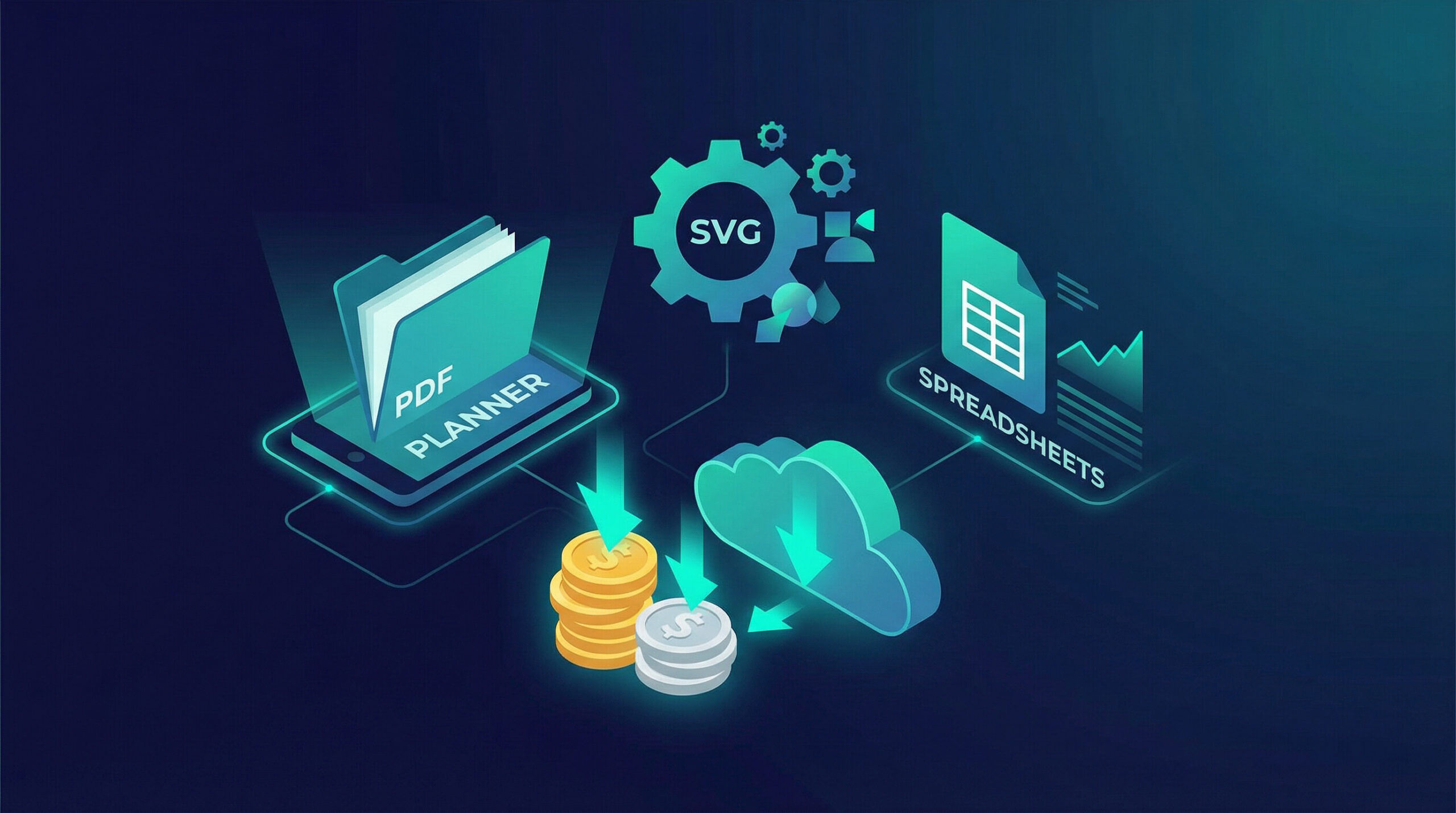
Digital products are the closest thing to pure passive income that exists. You create a file — a Notion template, a Canva planner, an SVG design, a pattern, a spreadsheet — and sell it forever. There’s no fulfillment cost, no material cost, and no limit to how many times you can sell the same file.
A well-designed planner template on Etsy can sell 2,000+ times at $4.99 each. That’s nearly $10,000 from a single product you made once. I’ve seen simple SVG cut files generate passive income for 3+ years after the seller created them.
The categories that consistently sell well: wedding planners and stationery, budget trackers, social media templates, printable art, SVG bundles for Cricut users, and digital journals. The market is big — global e-commerce revenue continues to climb year over year, and digital products have essentially zero marginal cost.
At MyDesigns, we’ve built our digital products workflow specifically around this model — tools for creating, organizing, and publishing digital product listings at scale.
Startup cost: $0–$25/month (Etsy listing fees are $0.20 each).
Time to first sale: Days if the product solves a real need.
Passive after: Immediately — every sale is passive income.
Try MyDesigns Free — Launch Your Digital Products Store →
3. AI-Generated Design Store
Here’s the contrarian take most people don’t want to hear: AI-generated designs are not a shortcut to easy money. Flooding a marketplace with 10,000 low-effort AI images doesn’t work. The platforms flag it, buyers ignore it, and your shop tanks.
But here’s what does work: using AI as a production tool for specific, well-researched niches. You identify a gap in the market — say, “minimalist hiking designs for Pacific Northwest enthusiasts” — and you use AI to produce 50 variations in days instead of weeks. Quality, intentional, niche-specific designs that happen to be AI-assisted.
That’s a fundamentally different approach, and it’s working. Our Dream AI feature is built exactly for this workflow — generating on-trend, commercially viable designs that you can push directly to your POD listings. It’s not about replacing creative skill. It’s about multiplying your output.
Pair it with our Vision AI tool to automatically generate compelling titles and descriptions, and you’ve got a near-complete production pipeline.
Startup cost: $38–$50/month (MyDesigns Pro plan includes Dream AI).
Time to first sale: 1–3 weeks with focused niche research.
Passive after: 30–60 days of consistent output.
4. Niche Mockup Template Shop
This one flies under the radar. Thousands of POD sellers desperately need high-quality product mockups to make their listings look professional. If you can create stunning mockup templates — lifestyle shots of t-shirts, mugs, wall art — and sell them to other sellers, you’ve built a recurring revenue stream serving a proven market.
The beauty of this model: your customers are motivated buyers with real budgets. A POD seller making $3,000/month will happily spend $50–$200 on mockup packs that help them sell more. The lifetime value of each customer is high, and the product is purely digital.
Our Mockup Generator gives you professional-grade mockup output that you can package and resell. The sellers who build mockup shops as a side business to their POD store often find it becomes more profitable than the store itself.
Startup cost: $49.99/month (MyDesigns Pro with mockup access).
Time to first sale: 2–4 weeks to build initial pack.
Passive after: Immediately once listings are live.

Ideas 5–8: Content & Affiliate Streams
These ideas take longer to build but tend to compound more aggressively. A good affiliate site or YouTube channel can generate income for 5–10 years from content you created once. The upfront work is real — but so is the long-term payoff.
5. Etsy Affiliate Marketing
Etsy’s affiliate program pays 4% commission on sales, but that’s not where the real money is. The better model: affiliate partnerships with the tools and resources you already use as an Etsy seller. Tools like Everbee (Etsy analytics and research) and EtsyHunt (keyword and competitor research) offer affiliate programs that pay recurring commissions — meaning you get paid every month a customer you referred stays subscribed.
A seller with an established YouTube channel, blog, or social media following can build a genuinely meaningful affiliate income just by recommending the tools they already use. The authenticity of “here’s what I actually use” converts far better than generic recommendations.
I know sellers making $2,000–$6,000/month in pure affiliate income by being genuine about their workflows. It’s not magic — it’s trust built over time.
Startup cost: $0 (just your time and existing presence).
Time to first commission: 30–90 days of audience building.
Passive after: 6–12 months of content creation.
6. Faceless YouTube Channel
You don’t need to show your face on camera to build a profitable YouTube channel. Thousands of channels in the POD and Etsy niche grow consistently by showing screen walkthroughs, design tutorials, product showcases, and strategy content — all narrated over screen recordings or illustrated with simple animations.
YouTube’s ad revenue averages $2–$10 per 1,000 views depending on niche. A channel with 50,000 subscribers in the e-commerce education space can generate $1,500–$4,000/month from ads alone. Add affiliate commissions and the number climbs significantly.
The niche I’d target right now: “how to sell on Etsy with print on demand.” High search volume, growing audience, and you can authentically demonstrate the exact tools you use in your own business. Every video is a long-term passive asset.
Startup cost: $0–$200 (screen recording software, basic mic).
Time to monetization: 6–12 months to reach YouTube’s 1,000 subscriber threshold.
Passive after: 18–24 months of consistent posting.
View MyDesigns Pricing — Plans from $0/month →
7. Canva Template Business
Canva has 170 million+ registered users. A meaningful percentage of them will pay for done-for-you templates that save them time. Social media templates, résumé designs, pitch decks, business card packs, Instagram story kits — all of these sell consistently on Etsy, Creative Market, and Gumroad.
The business model is identical to a digital products shop, but with a specific focus on editable design files. The advantage: Canva’s built-in sharing infrastructure means you can deliver templates instantly, and customers can customize them without needing design software.
A quality bundle of 30 Instagram templates at $15–$25 is a proven seller. Once you have 20+ bundles in your shop, the income becomes genuinely passive. The challenge is that this market is competitive — you need a clear niche and real design quality to stand out.
Startup cost: $13/month (Canva Pro).
Time to first sale: 1–3 weeks.
Passive after: 60–90 days with a diversified template catalog.
8. Niche Blog + Affiliate Income
A niche content site is one of the highest-ceiling passive income models on this list. You build a blog around a specific topic — say, “Cricut projects for beginners” or “Etsy seller tools and strategy” — and you monetize through affiliate commissions, display ads, and digital products.
The key word is niche. A general craft blog competes with millions of sites. A blog specifically about “selling SVG cut files on Etsy” has far less competition and far more targeted traffic. That targeted traffic converts at 3–5x the rate of general traffic.
Display ads through Mediavine or AdThrive pay $15–$40 RPM (revenue per 1,000 sessions) in e-commerce niches. A site generating 50,000 monthly sessions — achievable within 18 months with consistent content — earns $750–$2,000/month from ads alone, plus affiliate income on top of that.
This is a long-term play, but once a blog article ranks, it can generate traffic and income for years without updates.
Startup cost: $50–$100/month (hosting, domain).
Time to first income: 6–12 months (SEO takes time).
Passive after: 18–24 months of consistent publishing.
If you want better output, the workflow has to make launching easier, not harder.
The advantage usually goes to the sellers who can create, organize, and publish without getting buried in manual work.
Ideas 9–12: High-Leverage Knowledge & Curation
These four ideas require more upfront expertise but tend to generate higher per-transaction revenue. If you’ve been selling online for a year or more, you probably have more knowledge than you realize — and people will pay for it.
9. Print on Demand for Events
Event-based POD is dramatically underrated. Wedding merchandise, birthday party supplies, corporate retreat gear, team sports apparel — these are high-urgency, high-value purchases with built-in deadlines. The buyer can’t procrastinate because the event is happening on a specific date.
This creates a different dynamic than your typical Etsy shop. Conversion rates are higher because buyers are motivated. Repeat business is lower because events are one-time — but that’s offset by the fact that every wedding party has a bride, a groom, 8–12 bridesmaids and groomsmen, and often parents and guests who want matching gear.
The recurring angle is corporate clients. Land one mid-size company as a client for their annual conference gear, and you might do $3,000–$15,000 in a single order. I’ve seen this model built entirely around LinkedIn outreach to event coordinators.
Startup cost: $0–$50/month.
Time to first order: 2–4 weeks with direct outreach.
Passive after: Somewhat seasonal — less passive, more recurring.
10. Digital Course / Workshop
I know what you’re thinking: the online course market is saturated. Here’s the truth — the generic online course market is saturated. Courses that teach a specific, validated skill to a specific audience are still very much in demand.
“How to start a print on demand business from zero” is too broad. “How I built a 500-listing Etsy shop in 90 days using AI tools and bulk publishing” is specific, credible, and priced for buyers who are already motivated. The difference between those two is the difference between $200/month and $5,000/month.
Platforms like Gumroad, Teachable, and Kajabi handle the entire delivery and payment infrastructure. Once the course is recorded, every sale is passive income. A $197 course that sells 10 times per month is $1,970/month for content you created once.
Startup cost: $0–$99/month (platform fees).
Time to launch: 4–8 weeks for a solid course.
Passive after: Immediately, with some marketing ongoing.
11. Stock Photo / Digital Art Shop
If you create original artwork, photography, or illustrations, you can license them on multiple platforms simultaneously — Shutterstock, Adobe Stock, Etsy, Creative Market, and your own website. Each platform sale is a royalty payment for something you made once.
The mathematics of licensing are favorable. A single illustration that sells for $5 per license, but sells 200 times across 5 platforms, generates $1,000 from one piece of art. A catalog of 300 illustrations generating even modest sales across platforms creates a real income floor.
The often-missed opportunity: selling art as POD products alongside licensing. The same illustration can earn you a royalty on Adobe Stock AND print on a t-shirt in your Etsy shop. That’s double monetization of a single creative asset.
Startup cost: $0–$30/month (platform accounts).
Time to income: 3–6 months to build a meaningful catalog.
Passive after: 6–12 months with a diverse catalog.
12. Subscription Box Curation Service
Subscription boxes are a recurring revenue model at its most direct. You curate products around a specific niche — indie craft supplies, POD seller resource packs, digital creator tools — and charge a monthly fee. Subscribers pay before you ship, which means you’re cash-flow positive before you ever spend a dollar on product.
The physical product version requires more logistics — sourcing, packing, shipping. But the digital subscription box is nearly pure margin: a monthly bundle of digital resources, templates, designs, or tools, delivered via email or a private page. I’ve seen digital subscription boxes priced at $15–$39/month with 200–500 subscribers generating $3,000–$20,000 in monthly recurring revenue.
The key is niche specificity and consistent quality. “Monthly design bundle for Etsy sellers” beats “monthly creative bundle” every time.
Startup cost: $50–$200/month for digital version.
Time to first subscriber: 2–4 weeks with targeted marketing.
Passive after: 3–6 months once the delivery system is automated.
The difference between reading and publishing is where momentum usually gets lost.
If you want this strategy to actually turn into output, the workflow after the idea matters just as much as the idea itself.
How to Pick the Right Idea and Actually Start
Here’s the framework I give every seller who asks me which business model to choose: pick the one closest to what you already know, and start there. Not the most exciting one. Not the one with the highest theoretical ceiling. The one where you have the least learning curve.
If you already sell on Etsy, start with digital products or POD. If you already create content, start with affiliate marketing or YouTube. If you’re a designer, start with mockup templates or a stock art shop. If you have expertise in a field, start with a course.
The biggest mistake I see? People spend 6 weeks researching passive income ideas and never start. That research phase feels productive but it’s a form of procrastination. The real learning happens once you’re in the market, not before.
Pick two ideas. Set a 90-day goal for each. Put them on a calendar. Start today.
Concerns I hear constantly:
- “I’m not a designer.” Our Dream AI generates commercial-grade designs in seconds. You don’t need to be a designer anymore.
- “I don’t have time.” That’s the whole point of these models — the time investment is upfront, not ongoing. The correct reframe is: invest 60 hours now to save 60 hours per month later.
- “The market is too saturated.” Every market looks saturated from the outside. Inside specific niches, there’s always room for a better product, a better brand, or a better customer experience.
- “I don’t know where to start.” Start with print on demand. Zero inventory, zero capital risk, proven income model. Here’s everything you need to know.
The Tools That Make This Work
The passive income game changed when AI design tools and bulk publishing became accessible to individual sellers. What used to require a team — design, mockup creation, listing optimization, bulk upload — can now be done by one person with the right tools.
At MyDesigns, we’ve built the toolkit specifically for this stack:
- Dream AI — Generate original, on-trend designs at scale without design software.
- Mockup Generator — Professional product mockups in seconds, not hours.
- Bulk Publish — Push 50+ listings to Etsy and Shopify in the time it used to take to do 5.
- Vision AI — Auto-generate SEO-optimized titles and descriptions that actually rank.
- Digital Products Hub — Manage and deliver digital products from a single dashboard.
Pricing starts at free — genuinely useful, not artificially crippled. Starter plans are $18.75/month on annual billing, Pro is $38/month, and Pro Plus is $74.99/month. The math is simple: if bulk publishing saves you 10 hours per month and your time is worth $20/hour, the tool pays for itself in the first week.
The sellers who build real passive income aren’t necessarily the most talented. They’re the most systematic. They use tools that multiply their output, they focus on specific niches, and they keep going past the 90-day mark where most people quit. The income is real — the question is whether you’ll still be showing up when it arrives.
Turn Any of These Ideas Into Reality — Fast
MyDesigns gives you the tools to launch a POD store, sell digital products, and automate your listings in minutes — not months.
Frequently Asked Questions
Which of these 12 unique business ideas is easiest to start with no experience?
Print on demand is the easiest entry point. You don’t need inventory, capital, or design experience (AI tools handle the design side). You can have your first listing live on Etsy in under 24 hours. The learning curve is minimal, the risk is essentially zero, and the income potential scales significantly as you add more designs.
How much money can I realistically make from passive income online?
It depends heavily on the model, the time you invest upfront, and how niche-specific you go. Print on demand sellers with 300+ listings commonly earn $2,000–$8,000/month. Digital product shops with a strong catalog can earn $500–$5,000/month. Affiliate marketers with established audiences can earn $1,000–$10,000+/month. These aren’t guarantees — they’re what I’ve seen consistent, focused sellers achieve in 12–24 months of working the model.
Do I need to pay taxes on passive income from an online business?
Yes — passive income is still taxable income. In the US, you’ll typically receive a 1099 once you earn over $600 from a platform in a year. Keep records of your income and expenses (software subscriptions, platform fees, etc.) from day one. Consult a tax professional who understands self-employment income — there are legitimate deductions that reduce your taxable income significantly.
How long does it take for a print on demand store to become passive?
With consistent effort, most sellers see their store becoming genuinely passive — meaning it earns without daily attention — within 60–120 days. The threshold is roughly 200–300 active listings with optimized titles and tags. Below that threshold, you’re still in active building mode. Above it, the store generates revenue with only weekly maintenance. Tools like MyDesigns’ Bulk Publish dramatically compress the time to reach that listing count.
Can I run multiple passive income streams at the same time?
You can, but I’d caution against running more than two simultaneously until at least one is genuinely passive. The danger of spreading too thin is that nothing gets enough attention to gain traction. My recommendation: start with one design-based income stream (POD or digital products) and one content-based stream (affiliate marketing or a niche blog). Get the first one to $500/month before heavily investing in the second. That’s a realistic, sustainable path to building multiple income streams.


Leave a Reply