


Key Takeaways
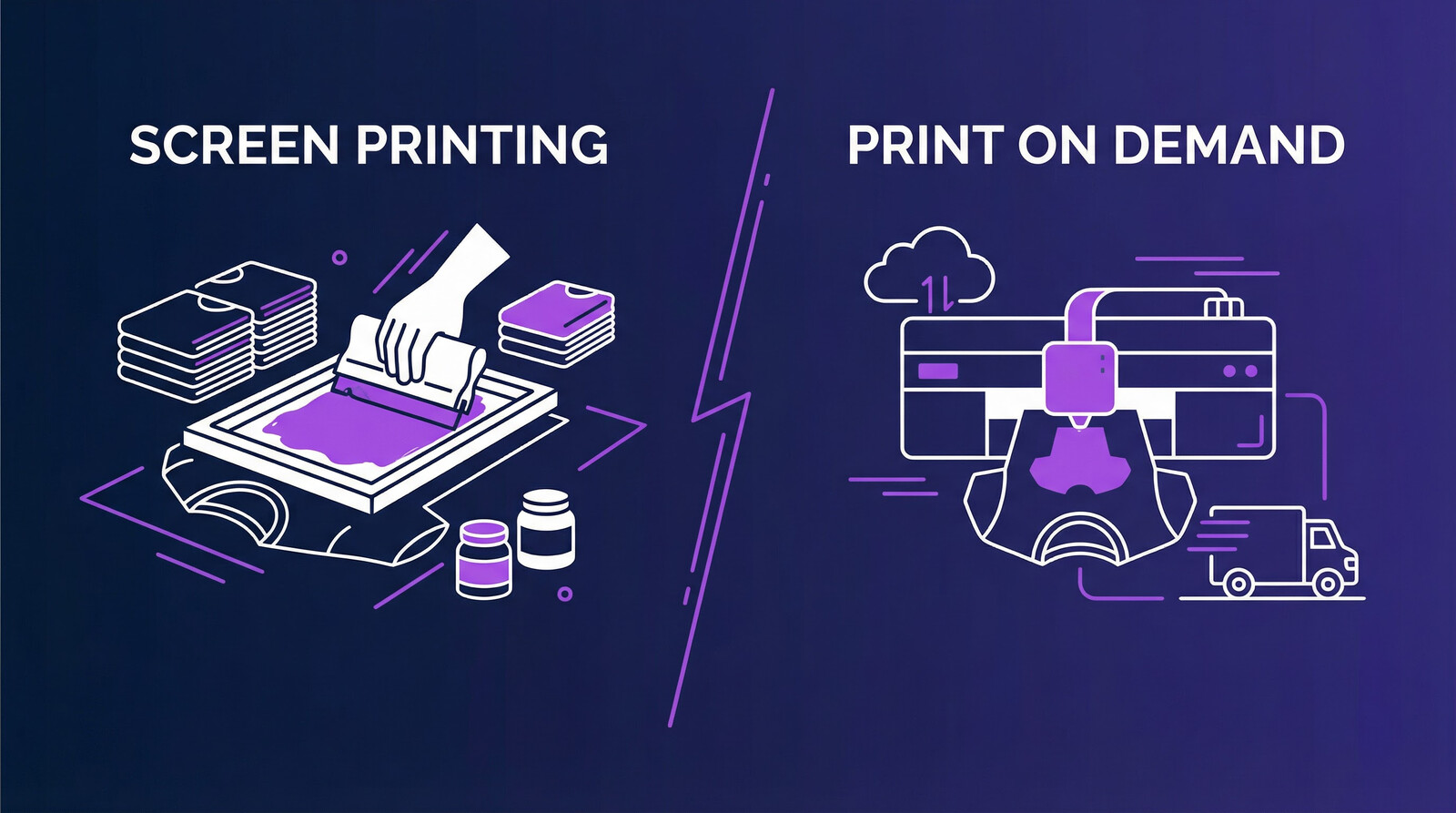
- Screen printing wins on quality and bulk cost — if you’re ordering 100+ units of the same design, screen printing will give you better margins and more vibrant colors than any POD alternative.
- Print on demand wins on risk and speed — zero upfront inventory, no minimums, and you can test 50 designs in the time it takes to set up one screen print run.
- Most successful sellers start with POD, not screen printing — you use POD to find your winning designs, then consider screen printing only after you’ve proven demand.
- The hybrid approach is underrated — POD for new listings and testing, screen printing for proven top sellers. You don’t have to pick one permanently.
Table of Contents
- What Is Screen Printing?
- What Is Print on Demand?
- Cost Comparison: Screen Printing vs Print on Demand
- Print Quality: Which Actually Looks Better?
- Which Is Right for Your Business?
- The Strategy Most Sellers Ignore: Do Both
- How to Scale a POD Business Without Touching Inventory
- Frequently Asked Questions
Most people frame this as a binary choice. Screen printing or print on demand — pick a side, plant your flag, defend it.
That framing is wrong. And it’s costing a lot of sellers real money.
I’ve watched sellers burn $3,000 on a screen printing run for a design they’d never tested, only to sit on 200 unsold hoodies in their garage. I’ve also watched POD sellers hit $30K/month in revenue without ever touching inventory. The difference wasn’t the printing method. It was the timing of when they used each one.
Here’s the full breakdown — no fluff, just what you actually need to know.
What Is Screen Printing?
How Screen Printing Works
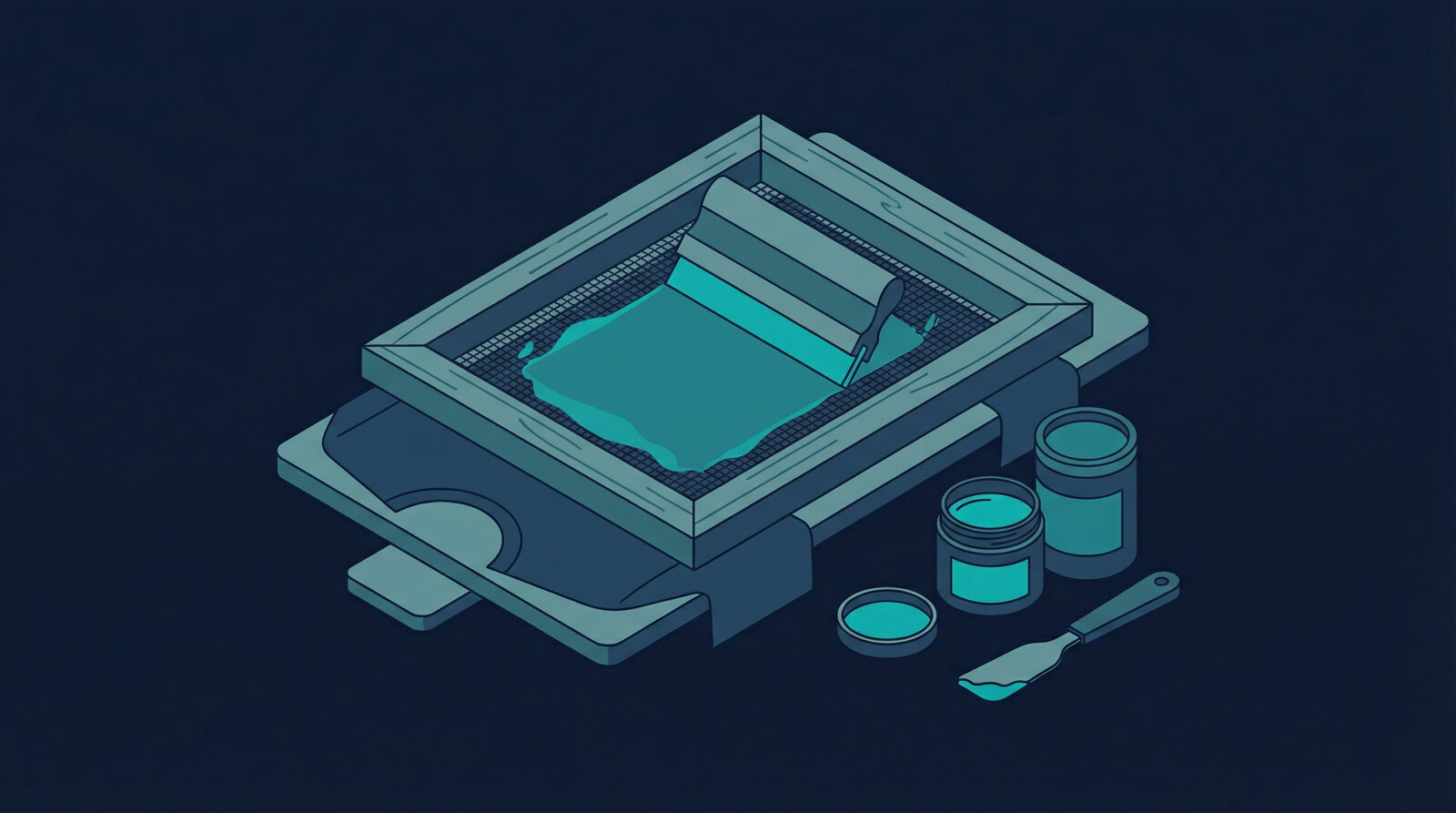
Screen printing is one of the oldest garment printing methods around. Your design gets burned onto a mesh screen, ink is pushed through the screen onto the fabric, and the result is a vivid, ink-saturated print with real texture you can feel.
Each color in your design requires a separate screen. A 4-color design means 4 screens, 4 setup passes, and a significantly higher setup cost than a simple 1-color logo. That’s why most screen printers have minimum order quantities — usually 24 to 72 pieces per design — to make the setup cost worthwhile.
Once those screens are made, though? The printer can crank out hundreds of shirts per hour at a fraction of the per-unit cost of almost any other method.
Pros and Cons of Screen Printing
The advantages are real:
- Exceptional color vibrancy — especially on dark garments
- Durable prints that hold up wash after wash
- Low cost per unit at scale (100+ pieces)
- Works beautifully for simple, bold designs
The limitations matter too:
- High minimum order quantities (usually 24–100+ units)
- Setup fees per design per color ($20–$50 per screen is typical)
- Not practical for photorealistic or gradient-heavy designs
- You’re holding inventory — if it doesn’t sell, you eat the cost
- Lead times of 1–2 weeks before you see a single unit
The inventory risk is the one most beginners underestimate. You’re making a financial bet on every design before you know if customers want it.
The better tool or platform is usually the one that helps you publish faster and scale without extra friction.
This is exactly where a cleaner workflow starts to matter more than another round of planning.
What Is Print on Demand?
How Print on Demand Works
Print on demand flips the model entirely. You create a listing, a customer buys it, and the POD provider prints and ships it directly to them. You never touch the product. You carry zero inventory.
Most POD providers use direct-to-garment (DTG) or dye sublimation printing — not screen printing. DTG works like a giant inkjet printer spraying directly onto the fabric. It’s incredibly flexible: full-color designs, photorealistic artwork, gradients, tiny text — all handled with no extra setup cost. Sublimation works by bonding dye into the fabric itself, making it ideal for all-over-print products.
The trade-off is cost per unit. A DTG-printed t-shirt from a POD provider typically costs $12–$18 to produce. A screen-printed shirt in a bulk run of 100 might cost $6–$9 each. That gap is real, and it matters for your margins.
Pros and Cons of Print on Demand
What makes POD powerful:
- Zero upfront inventory cost — no financial risk per design
- No minimums — you can list one product and never order it
- Test dozens of designs simultaneously without batch ordering
- Ships directly to customers from the fulfillment center
- Scale to thousands of SKUs without a warehouse
- Works globally — POD networks often have facilities in multiple countries
The real drawbacks:
- Higher cost per unit hurts profit margins at scale
- Less control over print quality (varies by provider)
- You’re dependent on the provider’s fulfillment speed
- Limited to whatever blank products the provider carries
For anyone selling on Etsy or Shopify without a warehouse, print on demand is how you get started without betting your savings on designs that might not sell.
Cost Comparison: Screen Printing vs Print on Demand
Let’s put real numbers on this. Assume a 100% cotton unisex t-shirt, sold at $29.99 retail.
| Factor | Screen Printing (100 units) | Print on Demand (per order) |
|---|---|---|
| Setup cost | $80–$200 (4-color design) | $0 |
| Cost per unit | $6–$10 | $12–$18 |
| Minimum order | 24–100+ units | 1 unit |
| Upfront cash required | $800–$1,200 | $0 |
| Profit per unit (at $29.99) | ~$18–22 | ~$10–16 |
| Inventory risk | High | None |
The margin difference is significant once you’re moving volume. At 500 units per month, screen printing could add $4,000–$6,000 in additional profit versus POD.
But you have to actually sell those 500 units first. And you have to know — upfront — which design to bet on.
That’s the trap. Most sellers don’t have that certainty until they’ve already tested the design through actual sales.
Comparison articles are useful, but the real question is always what gets you to execution faster.
The advantage usually goes to the sellers who can create, organize, and publish without getting buried in manual work.
Print Quality: Which Actually Looks Better?
Here’s the honest answer: screen printing produces more vibrant, tactile prints on most garments. The ink sits on top of the fabric with a slight texture. Colors pop differently than DTG. For bold, simple designs — logos, text, graphic tees — screen printing looks objectively better.
But there are scenarios where DTG wins.
Photorealistic artwork, full-color illustrations, photos, gradient-heavy designs — screen printing struggles with these. Each color needs its own screen, so a sunset illustration with 12 color transitions becomes a very expensive, imprecise process. DTG handles that without breaking a sweat.
All-over-print? Screen printing basically can’t do it. Sublimation owns that space.
The quality conversation also depends heavily on your POD provider. I’ve seen DTG quality that was shockingly good — and I’ve seen screen prints that cracked and faded after 10 washes. The method matters less than the execution.
If you’re creating intricate, artistic designs and selling to buyers who care about print quality, invest time in finding a POD provider that uses premium DTG equipment and pre-treats garments properly. The gap between a bad DTG print and a great one is enormous.
Which Is Right for Your Business?
When to Choose Screen Printing
Screen printing makes sense when:
- You’ve already validated demand for a specific design through real sales data
- You’re ordering 50+ units of the same design
- Your designs are bold and use fewer than 6 colors
- You have storage space and the cash flow to front inventory costs
- You’re selling to businesses (company merch, events, uniforms) where bulk orders are the norm
Screen printing is also the right call if you’re building a physical brand — a streetwear label, a band merch line, a local sports team supplier. The product quality supports premium pricing, and buying in bulk is baked into the business model.
When to Choose Print on Demand
Print on demand is the right starting point when:
- You’re testing new designs or new niches
- You want to list dozens (or hundreds) of products without upfront cost
- You’re running an Etsy or Shopify store and want passive income
- You don’t want to deal with inventory, packing, or shipping
- You’re selling to a global audience that benefits from distributed fulfillment
The ability to publish 50 designs in a weekend and let the market tell you which 5 are winners — that’s something screen printing simply can’t offer. It’s the reason POD has completely changed the economics of starting a product business.
A setup that looks good in theory but slows the workflow down is usually the wrong call.
If you want this strategy to actually turn into output, the workflow after the idea matters just as much as the idea itself.
The Strategy Most Sellers Ignore: Do Both
Here’s the take most comparison articles won’t give you: the best sellers don’t pick one method. They use both, at the right time.
The playbook looks like this:
- Launch with POD. List 50–100 designs across your niche. Use tools like bulk publishing to get them live fast. Let the market tell you what sells.
- Identify your top performers. After 60–90 days, you’ll know which 5–10 designs are generating consistent orders.
- Move winners to screen printing. Now you have demand data. You can confidently order 100 units of your top design knowing they’ll sell. Your margins on those improve significantly.
- Keep POD running for everything else. New designs, seasonal products, niche experiments — all through POD. No risk, maximum range.
I’ve watched sellers run this playbook and effectively double their margins on their best-selling products while still maintaining 500+ active listings through POD. The two methods aren’t competing — they’re serving different parts of the same strategy.
Services like Printify make the POD side of this easy — global fulfillment network, solid product range, competitive base costs. Pair that with automation tools that handle mockup creation and listing publishing, and the POD half of your catalog basically runs itself.
How to Scale a POD Business Without Touching Inventory
The manual approach to POD kills more businesses than the economics ever do. Uploading one product at a time, creating mockups individually, writing unique descriptions by hand — I’ve seen talented designers with great product ideas completely burn out before they hit $1,000/month because the operational load was crushing them.
The real opportunity in POD is volume. Not 10 listings. Not 50. Hundreds.
When we built MyDesigns, the core problem we were solving was exactly this bottleneck. Our mockup generator can produce 2,400 product mockups in seconds — the kind of output that would take a human days of manual work. Then bulk publishing pushes all of those live to Etsy or Shopify in one go.
We also built Vision AI specifically to generate SEO-optimized titles, descriptions, and tags from your design images — so you’re not writing listings from scratch. And Dream AI generates the design artwork itself if you don’t have a designer.
The sellers I’ve seen clear $10K/month with POD aren’t working harder than the ones stuck at $1K. They’re using systems that multiply their effort. That’s the actual advantage. [Insert screenshot of MyDesigns bulk publisher in action]
Whether you’re running a pure POD operation or the hybrid model described above, the operational side needs to be automated. Otherwise you’re trading one form of overhead (inventory and fulfillment) for another (manual listing work).
Check out our pricing — there’s a free plan to start, and paid plans begin at $18.75/month (annual billing).
Frequently Asked Questions
+ Is screen printing better quality than print on demand?
For bold, simple designs with few colors, yes — screen printing typically produces more vibrant, tactile results that last longer. However, for photorealistic artwork, gradients, or all-over prints, DTG and sublimation (used by most POD providers) are actually superior. The best method depends on your specific design style.
+ Can you do print on demand with screen printing?
Almost no major POD providers offer true screen printing, because the setup costs and minimums are incompatible with the on-demand model. Instead, POD services use DTG (direct-to-garment) or sublimation printing — both of which allow single-unit orders with no setup fees.
+ Which is more profitable: screen printing or print on demand?
Screen printing has better per-unit margins once you’re ordering in bulk (50+ units), often $4–$8 more profit per shirt versus POD. But POD has zero upfront risk and no unsold inventory. Most high-volume sellers use POD to test designs and screen printing to scale proven winners — this hybrid approach maximizes both margin and flexibility.
+ How much does screen printing cost vs print on demand?
Screen printing typically costs $6–$10 per unit (for 100-unit runs) plus $80–$200 in setup fees per design. Print on demand costs $12–$18 per unit with zero setup fees and no minimum order. At low volumes, POD is cheaper. At high volumes (100+ units of the same design), screen printing wins on cost per unit.
+ Should I start with screen printing or print on demand?
Start with print on demand. It lets you test designs with zero financial risk, find out what your customers actually want to buy, and build revenue without tying up cash in inventory. Once you’ve identified your best-selling designs through real sales data, that’s when it makes sense to explore screen printing for your proven winners.
Screen printing and print on demand aren’t enemies. They serve different stages of the same business. Start with POD — it’s the only sensible way to test without risk. Scale your winners with screen printing when you have the data to justify the commitment.
Most sellers who struggle with POD aren’t struggling because of the method. They’re struggling because they’re doing it manually at a scale that doesn’t work. The sellers who win are the ones who automate the repetitive parts and keep their focus on design and strategy.


Leave a Reply