



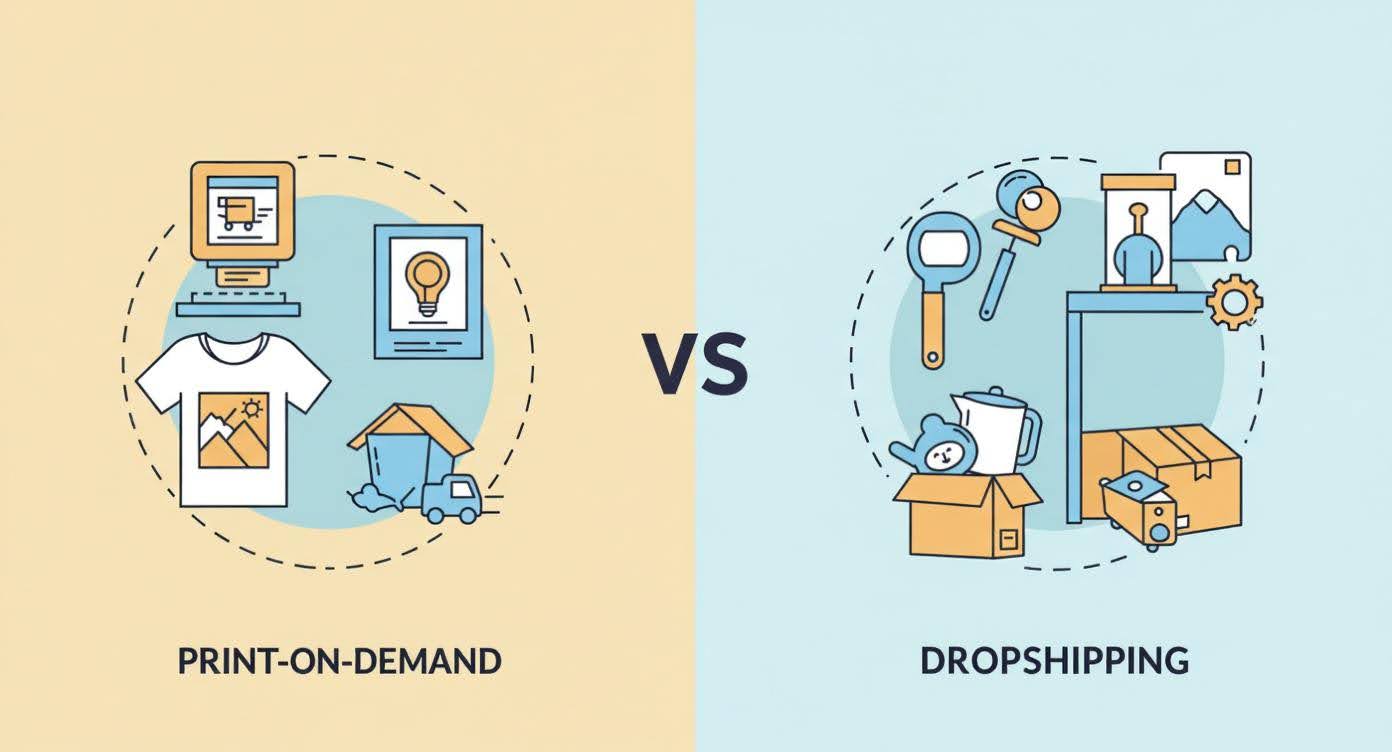
 Before we pit POD against dropshipping, it’s worth noting what they have in common. Both models offer a lightweight, flexible approach to e-commerce. Key similarities include:
- No Inventory Holding: In both POD and dropshipping, you don’t need a physical storefront or warehouse for stock. Products are stored (or produced on the fly) by your supplier and sent directly to customers. This means no upfront inventory costs and no worries about unsold stock – a huge advantage for small businesses and side hustlers.
- Low Startup Costs: Because you aren’t buying inventory in bulk, the initial costs are minimal. You can launch a store by paying only for a website or marketplace fees and some product samples. This frees up cash to invest in other areas like marketing or branding. It also lowers the risk – you’re not sunk if a product doesn’t sell.
- Outsourced Fulfillment: Both models rely on third-party suppliers to handle fulfillment (storage, packaging, and shipping). This saves tremendous time for you as the business owner. Instead of packing boxes, you can focus on growing the business (finding new products or designing new art, optimizing your listings, serving customers, etc.).
- Global Reach: Working with suppliers (or print providers) that ship worldwide means you can reach customers globally from day one. Many dropshipping suppliers have international warehouses, and print-on-demand companies often print in multiple regions. This allows even a one-person business to sell internationally without complex logistics.
- Scalability: Since you’re not constrained by how much stock you can buy or store, scaling up is easier. Got a winning product? Both models let you sell 10 units or 10,000 units without changing your fulfillment process – the supplier or print provider will handle the volume as long as they have capacity. This on-demand model scales gracefully compared to traditional retail.
Of course, with these similarities come some common challenges. Relying on third parties means you must ensure those partners are trustworthy and consistently deliver quality service. If a supplier runs out of stock or a print provider has machinery issues, your orders could be delayed.
Communication is key: successful dropshipping and POD sellers build solid relationships with their suppliers and monitor performance closely (e.g. tracking if orders ship on time, checking customer feedback on product quality).
Both models also put the onus on the seller to handle customer service and returns, even though you didn’t produce or ship the product yourself. You’re the face of the business to the customer, so you’ll be handling any complaints or return requests. This can get tricky, as we’ll discuss under returns policies differences.
Overall, print-on-demand and dropshipping both enable lean e-commerce startups: no inventory, low cost, easy scaling. They’re often mentioned in the same breath for good reason – POD is essentially a subset of dropshipping focused on custom printed goods. But the differences between them are what will likely influence which path is right for you.
Now let’s compare POD and dropshipping head-to-head. While their fulfillment mechanics are alike, there are significant differences in what you sell and how you operate:
1. Product Customization & Uniqueness
 The biggest difference is customization. In print-on-demand, you are creating a unique product each time by adding your original design. Your T-shirt or mug design is one-of-a-kind, not available from any other seller unless they copy you. This means your product line can be completely unique to your brand, helping you stand out.
By contrast, with dropshipping you’re typically selling a supplier’s pre-made product that many other sellers might also be listing. There’s usually no personalization; you’re selecting items that already exist (say a certain phone charger or a generic fashion item) and selling them as-is. Multiple stores may carry identical products, so competition can be fierce on those items.
If branding and creativity are important to you, POD gives you far more scope. You can build a brand around your designs, which could foster customer loyalty if people like your style. Dropshipping tends to favor those who excel at trend-spotting and marketing – finding a hot product and aggressively advertising it can work, even if others sell it too, as long as you reach the customer first.
Product personalization is also a growing trend with consumers. In fact, research by Deloitte found that 1 in 5 consumers are willing to pay 20% more for personalized products or services. Print-on-demand enables this kind of personalization (e.g. allowing customers to add their name or choose colors on a product) far more readily than generic dropshipping does.
2. Product Range and Selection
Dropshipping offers a massive range of products to choose from. Suppliers and wholesale directories give access to everything from electronics to beauty products, gadgets, home décor, toys, you name it. As a drop shipper, you can curate almost any niche. Want to run an online pet supply store? You can dropship pet toys, beds, grooming tools, etc. Or a tech gadget store? Plenty of suppliers for that. The breadth of product categories in dropshipping is virtually unlimited – if it exists, you can probably find a supplier to dropship it.
In print-on-demand, the product range is more limited to printable blanks (apparel, accessories, print posters, etc.). The most common POD products are things like T-shirts, hoodies, mugs, phone cases, wall art, stickers, tote bags, hats, and similar items that can be printed or embroidered. While there are dozens of options (and new printable products do emerge), you won’t be selling, say, power tools or kitchen appliances via POD. Your focus will be on creative merchandise and possibly some custom printed home goods.
That said, successful POD sellers often expand their collections by printing on many kinds of items. For example, if your niche is yoga-themed designs, you could offer yoga quote T-shirts, yoga art prints, yoga mugs, and so on – a variety within the POD scope. And POD suppliers continue to add new product types (sometimes you’ll even see POD jewelry, custom print kitchenware, etc.). It’s just inherently tied to things that can have a design printed or attached.
3. Competition & Market Saturation
With dropshipping, because products are non-unique, competition is largely about who can market or rank better. Often, many stores source from the same big suppliers. For instance, a trendy LED gadget might be sold by dozens of Shopify stores all sourcing from one manufacturer. This means customers could find identical products elsewhere, potentially for cheaper.
Price competition can erode margins quickly in dropshipping. Additionally, if a product becomes a viral bestseller, expect a flood of copycat sellers. To succeed, drop shippers often focus on niche curation (finding unique items not everywhere yet) or building a strong brand story and customer experience that gives them an edge even selling common items.
In print-on-demand, competition plays out differently. Since your designs are unique, you aren’t directly competing on the exact same product. However, you are competing for the customer’s attention and dollars in general. If you sell funny cat-themed T-shirts, other POD sellers also sell funny cat T-shirts – but with different designs. Your competition is more about design quality, originality, and understanding your target niche. A great design that resonates with a community can make your product a hit where others fall flat.
Also, the POD market has grown, but it’s still less saturated item-for-item because each item is distinct. A strong niche design can carve out its own market. As Shopify’s research notes, print-on-demand products are inherently niche-friendly and can face less direct price competition because of their uniqueness.
4. Branding Opportunities
 Branding potential is significantly higher with print-on-demand. When you create custom products, you’re effectively producing your own brand of merchandise. You can put your logos, slogans, and brand personality front and center on products. Many influencers, YouTubers, and creators use POD to launch merch lines that reinforce their brand image (think of a gaming streamer selling T-shirts with their catchphrase, or an artist selling prints of their artwork). POD lets you build a cohesive brand catalog that’s unique to you, which can be a long-term asset if you grow a following.
Dropshipping, on the other hand, often involves selling third-party brands’ products. Unless you invest in private labeling (working with suppliers to add your brand to the products or packaging), your brand might only be present on your website design and customer service, not on the products themselves. Some dropshipping suppliers now offer branded packaging or inserts for your business, which helps a bit. But generally, the customer knows it’s a generic product. They might not remember your store name after purchase if there’s nothing branded about the item. This isn’t to say you can’t build a brand with dropshipping – some entrepreneurs do by curating a niche collection and crafting a compelling story around their store. It’s just inherently harder to have a unique brand identity when another shop could sell the same item.
If your goal is to create a memorable brand or launch a line of products under your name, POD is a more straightforward path. You could even use it to produce branded merchandise for an existing business (e.g., a gym owner selling gym apparel with their logo – that’s POD). Dropshipping might be more appropriate if branding is less important than quick sales (for example, if you’re testing various products to see what sticks).
5. Profit Margins and Pricing
Profitability can vary widely in both models, but there are some trends. Dropshipping products are bought one-by-one from suppliers at near-wholesale prices, and you mark them up. The margins can be decent if you find a cheap source and can sell at a higher perceived value. For commodity items, though, margins often shrink – if everyone sells the same $15 item, the one who sells at $14 might win the sale, cutting into profit. POD products have base costs that include the printing service, which can be relatively high per unit.
For instance, a POD T-shirt might cost you $12 to have printed and shipped, and you sell it for $20 – a $8 gross profit. In dropshipping, you might find a similar generic T-shirt for $5 from a supplier and sell for $20 – $15 profit. So on the surface, dropshipping can seem to have higher margins.
However, POD allows for premium pricing when customers value the design or personalization. People will pay more for a shirt that has a cool design they can’t get elsewhere, or a mug with their name on it. Many successful POD sellers enjoy 40-50% profit margins on their products by targeting the right niche and price point. In fact, it’s reported that the majority of successful POD merchants use roughly 40-45% profit margins on their products. Dropshippers may operate on slimmer margins (20-30% or even lower) unless they have an exclusive product source or a strong brand presence. Additionally, with POD you have control over the product’s perceived value – your art or brand can justify a higher price independent of the item’s base cost.
Another consideration: both models often incur similar shipping costs passed from the supplier. But if you dropship from overseas (e.g., many suppliers are in China), you might face very long shipping times or higher express shipping fees. Some customers will pay more for faster local shipping, which is why many dropshippers now use suppliers with US/EU warehouses even if base cost is higher.
Print-on-demand providers often print regionally (e.g., a US order prints in the US), which can mean more reasonable shipping times for domestic orders. Overall, to maximize profits in either model, you’ll need to carefully price your products, optimize your supply chain (maybe use multiple suppliers or printers), and keep an eye on advertising costs so they don’t eat all your margins.
6. Handling Returns and Customer Service
When it comes to returns or issues, there is a subtle difference in how easy it is to resolve:
- Dropshipping returns: Since the products are standard, many dropshipping suppliers have clear return policies and can accept returns for defects or customer dissatisfaction. If a customer receives a broken item or wants to return it unused, you can often coordinate with the supplier to get a replacement or refund. You’ll usually need to communicate between the customer and supplier – you act as the go-between – but it’s similar to any retail operation.
- POD returns: With print-on-demand, each item is made specifically for the customer. This makes returns trickier. If a customer simply doesn’t like the product or ordered the wrong size, the printed item often can’t just be put back in inventory – it’s custom-printed, essentially unsellable to anyone else. Many POD sellers therefore adopt a no returns policy for buyer’s remorse or incorrect sizing, and only offer replacements/refunds if the product is defective or the print quality was poor.
In short, dropshipping has a slight advantage in returns flexibility, whereas POD requires tighter policies. Customer service in both cases is your responsibility – you’ll be fielding emails about “Where is my order?” or complaints. That’s why it’s crucial to work with reliable partners and to communicate clearly with customers about expected shipping times, etc. Using tools for order management can help keep track of everything. For example, the Order Management dashboard in MyDesigns consolidates all your marketplace orders in one place, making it easier to oversee fulfillment status and address issues quickly.
 The e-commerce world is always evolving, and both print-on-demand and dropshipping are benefiting from broader trends in 2025:
- AI and Automation: The use of AI is reshaping how products are designed, marketed, and managed. For POD, generative AI can create design ideas in seconds (MyDesigns’ Dream AI uses models like Stable Diffusion and DALL·E to help sellers create original artwork). AI writing tools can draft product descriptions and titles – for example, Vision AI and Phraser AI can generate SEO-friendly titles, tags, and descriptions for your listings, saving you tons of time in optimizing product listings.
- Hyper-Personalization: Consumers increasingly seek personalized shopping experiences and products. This is a strong tailwind for POD. Not only do buyers appreciate unique designs, but offering product personalization (like custom text or images on an item) can boost conversion rates. We already mentioned willingness to pay more for personalization. In 2025, expect more integration of customization features in online stores.
- Social Commerce & Niche Communities: Selling directly through social media platforms is on the rise. TikTok, Instagram, and even Pinterest have smoother shopping features now. A recent report projects that social platforms will drive over 10% of e-commerce sales by 2025 (up from 7% today). This is great for visually appealing products – like a catchy T-shirt design or a cool gadget – which can catch fire on social media.
- Improved Supply Chains: The dropshipping model has matured, and many suppliers now have faster shipping options or domestic warehouses to serve key markets. This helps address the long shipping time issue. Additionally, more print providers have multiple fulfillment centers globally, meaning a customer’s order can be produced closer to them. In 2025, we’re seeing the gap in delivery times between POD/dropshipping and traditional retail closing gradually. This reduces a major friction point for customer satisfaction.
- Sustainability: Modern consumers care about sustainability and ethical business. Print-on-demand can actually be positioned as a greener model than traditional retail because it produces items on-demand, avoiding excess manufacturing. There’s less waste from unsold inventory. Some POD providers also offer eco-friendly product options (like shirts made of organic cotton, etc.).
- Multi-Channel Selling: Successful sellers in 2025 aren’t sticking to just one platform. You might start on Etsy, but then also launch a Shopify store, list on Amazon, and explore new channels like TikTok Shop or WooCommerce for WordPress. Managing all these can be a headache manually. That’s where tools like MyDesigns come in handy – its Multi-Product Publishing and channel integrations let you push listings to Etsy, Shopify, Amazon, WooCommerce, and TikTok Shop all from one dashboard.
In summary, both models are alive and well in 2025, far from being “saturated” to the point of no return, they’re evolving with new technology and consumer preferences. Print-on-demand in particular is riding the wave of the creator economy and personalization trend, while dropshipping continues to thrive as global e-commerce expands.


Leave a Reply