


Print on demand t shirts are still one of the fastest ways to launch a real ecommerce business without betting a pile of cash on inventory. That said, most sellers still approach shirts like it is 2019. They upload a generic design, pick one blank, and hope the algorithm does the rest. That is why so many stores stall out before they get traction.
I have watched sellers waste weeks polishing one shirt idea when they should have been testing ten. The advantage today is not being slightly more creative than the next person. It is moving faster, spotting angles sooner, and launching enough variations to find what the market actually wants.
If you want to build a print on demand t shirt business in 2026, I would keep it simple. Pick a niche with buying intent, create cleaner visuals than the average seller, and publish faster than your competitors can react. That is the play. In this guide, I will show you exactly how I would do it.
Key Takeaways
- Print on demand t shirts still work – but only if you treat them like a testing business, not a one-design hobby.
- Niche clarity beats broad creativity – specific buyers convert faster than generic “funny shirt” traffic.
- Mockups and listing quality decide the click – bad visuals kill momentum before pricing even matters.
- Speed compounds – the sellers who publish more strong variants usually learn faster and win faster.
Table of Contents
- What print on demand t shirts actually are
- Pick a niche with buying intent
- Your design system matters more than one great idea
- Mockups make or break print on demand t shirts
- How I would launch a shirt catalog fast
- Pricing, margins, and why volume beats perfection
- Best platforms to sell print on demand t shirts
- Frequently Asked Questions
Print on demand t shirts are simple. The business around them is not.
At the basic level, print on demand t shirts are shirts produced only after a customer places an order. You create the design, connect a print provider, publish the listing, and the provider handles printing and shipping.
That simplicity is why the model is attractive. No garage full of blanks. No huge minimum orders. No guessing whether 200 units of one design will sell.
But here is the part beginners underestimate: the hard part is not the fulfillment. The hard part is choosing the right market, creating better creatives, and publishing with enough speed to gather real data. That is exactly why platforms like MyDesigns Multi-Product Publishing and Listing Management matter so much once you move past your first few listings.
Why shirts still win
T-shirts are still one of the best entry products because demand is broad, personalization works, and trends move fast. They also give you room to test humor, identity, lifestyle, hobbies, causes, local pride, and seasonal moments without rebuilding your whole business model every time.
That flexibility is why the category keeps surviving. Not because shirts are magical. Because they are testable.
Where most beginners go wrong
Most new sellers think the winning move is finding one viral design. I do not buy that. The better move is building a repeatable system for generating multiple good designs, stronger mockups, and cleaner listings. One seller can get lucky. A system scales.
Most shirt sellers do not need more ideas. They need a faster launch loop.
If you want to test more niches and design angles without turning this into a full-time manual job, start with the workflow stack that lets you create, mock up, and publish faster.
Pick a niche with buying intent, not just attention
If I were launching print on demand t shirts from zero today, I would not start with broad categories like funny shirts, cool shirts, or trendy shirts. Those are crowded and lazy. I would start with a buyer identity or moment.
Think occupations, life stages, hobbies, communities, events, or gift occasions. A shirt aimed at a specific buyer usually converts better than a design trying to appeal to everyone.
Niche signals I like
- Clear self-identity: dog moms, nurses, mechanics, softball dads, homeschool moms
- Specific occasions: birthdays, graduations, Father's Day, team trips, bachelorette groups
- Repeatable design language: retro fonts, minimalist line art, distressed vintage, bold statement tees
- Search behavior you can map to listings and mockups
For idea validation, I would study marketplace demand, browse Etsy suggestion behavior, and cross-check with broader product direction. If you need inspiration, my guide on best things to sell on Etsy is a useful starting point.
Niches I would avoid
I would avoid vague inspiration quotes, generic meme shirts, and design directions with no real buyer identity. Those niches feel easy because the barrier to entry is low. That is exactly the problem.
The old POD playbook said you could win by uploading enough random designs. In 2026, that is mostly noise. The real edge is tighter relevance plus better production speed.
When you have the niche, the next bottleneck is creating enough strong variations.
That is where Dream AI helps. You can turn one direction into multiple shirt-ready creative angles without staring at a blank canvas for an hour.
Your design system matters more than one great idea
I have seen sellers burn days perfecting one concept and then wonder why growth is slow. That is backwards. What you want is a repeatable design system: a small set of visual directions, text treatments, layout patterns, and niche hooks you can reuse across multiple launches.
For shirts, that might mean one retro text system, one bold statement system, one minimal line-art system, and one personalization system. Suddenly you are not creating every listing from scratch. You are making smarter bets inside a framework.
This is also where AI can either help or hurt you. If you let it generate generic garbage, you will blend into the feed. If you use it to accelerate concept exploration, phrase generation, and variation building, it becomes a serious advantage. That is the difference I talked about in my breakdown of AI design tools for print on demand.
I would rather have 30 coherent, niche-aware shirts launched in a week than one “perfect” shirt still sitting in Canva drafts. Because the market only pays you after the listing is live.
Mockups make or break print on demand t shirts
Bad mockups kill good ideas. Period.
A shirt can have a strong niche angle and still flop if the first image looks cluttered, cheap, or hard to read. On marketplaces like Etsy, the click is everything. No click, no conversion. No conversion, no data. No data, no scaling.
What a high-click mockup needs
- A design that reads fast at thumbnail size
- Shirt color choices that support the artwork instead of burying it
- Clean backgrounds and realistic presentation
- Enough variation to test what buyers respond to
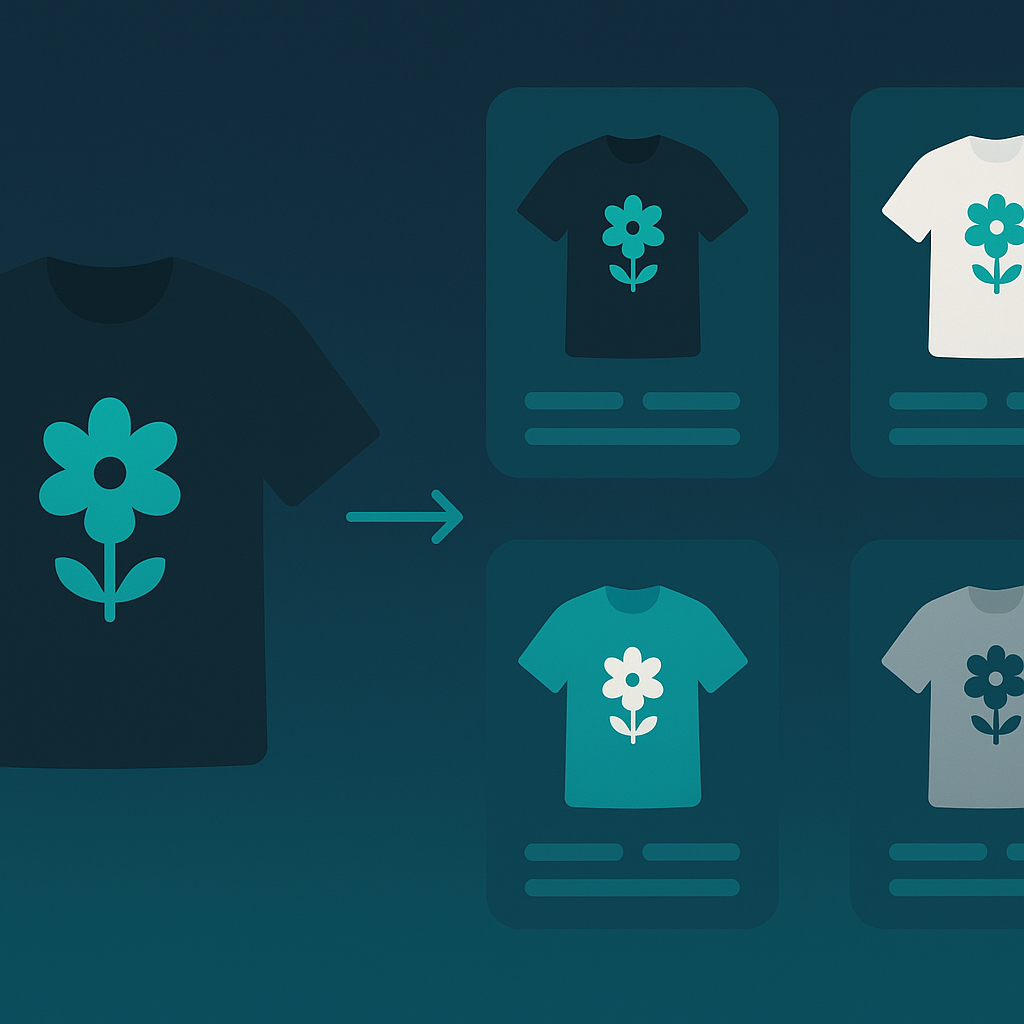
This exact bottleneck is why we built Product Mockups in the first place. Once you can generate and compare multiple shirt scenes quickly, you stop treating visuals like a one-shot decision.
If mockups are a weak spot for you, read how to make Etsy mockups and my product mockup generator guide. Both will save you time.
If your mockup looks average, your shirt usually gets judged as average too.
Use MyDesigns to create more mockup variants, compare shirt colors, and publish cleaner listings without rebuilding every product image manually.
How I would launch a shirt catalog fast
If I were building a new shirt store right now, I would not wait until every design felt polished enough for a museum. I would run a launch sprint.
The seven-day launch sprint
| Day | Focus | Output |
|---|---|---|
| 1 | Niche selection and angle mapping | 3 buyer segments, 10 design hooks each |
| 2 | Design creation | 15-20 viable shirt designs |
| 3 | Mockup production | 2-3 mockup variations per design |
| 4 | Title, tags, and listing polish | SEO-ready listings |
| 5 | Bulk publishing | First catalog live |
| 6-7 | Review early click data | Keep, improve, or cut weak listings |
That approach gives you signal fast. It also forces you to think like an operator instead of an artist waiting for inspiration.
For the publishing part, this is where tools like Bulk Publish and Import & Sync start saving real hours. I do not say that as marketing fluff. I say it because repetitive publishing work is one of the fastest ways to lose momentum.
Pricing, margins, and why volume beats perfection
You absolutely need to understand your numbers. I covered that in detail in my print on demand profit margin guide. But the short version is this: you are not building a shirt business by squeezing every last dollar out of one design. You build it by creating enough quality offers that a percentage of them turn into repeatable winners.
That does not mean pricing carelessly. It means understanding that catalog depth plus creative testing usually matters more than obsessing over a 50-cent pricing tweak on day one.
I have seen sellers get stuck adjusting prices every week while ignoring the bigger problem: their offer was not interesting enough to earn the click in the first place.
The goal is not one lucky shirt. The goal is a repeatable catalog machine.
When you are ready to move beyond manual uploads and scattered files, MyDesigns gives you one place to manage design creation, mockups, listings, and publishing.
Best platforms to sell print on demand t shirts
The best platform depends on your starting point. Etsy is still great if you want built-in buyer traffic. Shopify makes sense when you want more control. Amazon can work if you understand the rules and are willing to play a longer game.
If you are unsure where to begin, start with one sales channel and one fulfillment flow. Simplicity wins early. You can always expand once the first channel proves demand.
I would also keep an eye on workflow fit. If your designs, mockups, and listings live in five disconnected tools, scaling gets messy fast. That is why I prefer building a cleaner operating system around the business from the start. You can learn more on the MyDesigns print on demand page and compare marketplace strategy in Shopify vs Etsy.
That is the bigger shift happening right now. The old edge in POD was access. The new edge is execution speed. The sellers who build tighter systems will beat the sellers who just keep uploading more random shirts.
Frequently Asked Questions
+ Are print on demand t shirts still profitable in 2026?
Yes, print on demand t shirts are still profitable in 2026 if you choose a real niche, use better mockups, and test enough designs to find winners. The sellers struggling are usually not losing because shirts do not work. They are losing because their offers look generic.
+ What is the best platform for selling print on demand t shirts?
Etsy is often the easiest place to start because it has built-in buyer traffic. Shopify is better when you want full control of your brand and customer journey. The right answer depends on whether you want easier discovery or stronger ownership.
+ How many t shirt designs should I launch at the start?
I would aim for at least 10 to 20 viable designs instead of betting everything on one. More quality tests give you better signal on what niches, phrases, and mockups are actually working.
+ What type of designs work best for print on demand t shirts?
Designs with clear buyer identity usually work best. That includes niche statements, event-specific concepts, community humor, and visuals that read quickly at thumbnail size. Broad generic artwork tends to underperform.
+ Do I need design skills to start a print on demand t shirt business?
No, but you do need taste and a process. You can use tools, templates, and AI to speed up creation. What matters most is whether your final designs and mockups feel relevant, clear, and worth clicking.
If I were starting today, I would not obsess over making the perfect shirt. I would build the fastest clean testing system I could, get designs live, and let the market tell me where to go next.


Leave a Reply