



Print on demand profit margin is the number most sellers get wrong, and it is usually why they think their shop is growing when it is actually leaking cash.
I have watched sellers celebrate a $10 spread on a shirt, then realize later that Etsy fees, shipping, discounts, and ad spend quietly ate most of it. That is the trap. Gross markup feels good. Net profit is what keeps your business alive.
If you are wondering is print on demand profitable in 2026, the honest answer is yes, but only if you price like an operator and stop pretending platform fees are a rounding error. I am going to break down what a good POD margin actually looks like, how to calculate it on Etsy, what products usually carry better margins, and how I would price a store from scratch today.
Key Takeaways
- A healthy print on demand profit margin usually lands between 20% and 35% net after product cost, shipping, Etsy fees, and a realistic buffer for marketing or discounts.
- Most sellers underprice their products because they calculate from base product cost instead of total landed cost.
- Personalized and premium products usually beat commodity tees on margin because buyers compare value, not just sticker price.
- The old POD playbook of cheap designs and cheap pricing is dead – the real edge now is faster testing, cleaner math, and better product selection.
Table of Contents
- The short answer on print on demand profit margin
- How to calculate print on demand profit margin
- Real Etsy profit margin examples
- What is a good POD margin really?
- Products with better margins than basic tees
- The biggest profit killers in POD
- How I would price a POD store today
- Why the old POD playbook is dead
- Frequently Asked Questions
The short answer on print on demand profit margin
If you want the fast answer, a solid print on demand profit margin usually falls between 20% and 35% net. That means after you account for product cost, shipping, Etsy fees, payment processing, and some kind of buffer for discounts or advertising.
Can you hit 40% or more? Yes. I have seen it. But it usually happens with higher perceived value products, tighter niches, personalization, or a brand strong enough to avoid price wars. It is not what most generic shirt shops are doing.
What counts as profitable POD in 2026
In 2026, I do not think the right question is just is print on demand profitable. The better question is profitable compared to what.
If your goal is a side hustle that generates a few hundred dollars a month, you can survive with thinner margins for a while. If your goal is a real business, thin margins become dangerous fast. One bad supplier change, one shipping increase, or one offsite ad hit can wipe out the order.
That is why I like thinking in bands. The broader market is still there. US ecommerce keeps growing, which is why smart sellers are still willing to build here if the numbers work. Statista’s retail ecommerce data is a useful reminder that demand is not the real problem. Bad unit economics are.
- Under 15% net margin – fragile, stressful, and hard to scale
- 15% to 25% net margin – workable, but only if volume is strong and returns stay low
- 25% to 35% net margin – healthy and scalable for most Etsy POD shops
- 35%+ net margin – great, usually tied to premium positioning or personalization
Why so many sellers misread their margins
The common mistake is simple. Sellers use this math:
Selling price – product cost = profit
That is not profit. That is wishful thinking.
Real margin gets hit by Etsy fees, payment processing, shipping surprises, discounts, listing fees, and sometimes offsite ads. If you are not modeling those before you publish the listing, your store will feel busier than it actually is.
This is also why I tell newer sellers to read our Print on Demand for Beginners guide before they obsess over getting more traffic. More traffic into a bad margin model just scales the problem.
When you are ready to test pricing faster, this is exactly where a tool like Listing Management and Bulk Publish starts paying for itself. You can fix margin mistakes across multiple listings without manually editing your whole shop.
The sellers who win on Etsy usually move faster than the ones still polishing drafts.
This is exactly where a cleaner workflow starts to matter more than another round of planning.
How to calculate print on demand profit margin

You do not need fancy spreadsheets to get this right. You just need honest inputs.
Costs you cannot ignore
Before I price any POD product, I account for all of this:
- Base product cost
- Print or personalization cost
- Shipping cost
- Etsy listing fee
- Etsy transaction fee
- Payment processing fee
- Ad spend allocation or discount buffer
- Design cost or time cost
- Refund and issue buffer
If you sell on Etsy, study the current fee structure directly from Etsy’s seller pricing page and fee policy. If you ship inside the US, it also helps to keep an eye on USPS commercial pricing because shipping changes can quietly crush a margin that already looked tight.
The formula I use
Here is the formula I trust:
Net Profit = Total Revenue – Total Cost
Profit Margin = Net Profit / Total Revenue x 100
And for Etsy sellers, I define total revenue as:
Item price + shipping charged to customer
I define total cost as:
Product cost + shipping cost + Etsy fees + payment processing + listing fee + ad or discount buffer + design or overhead allocation
That last part matters. I always add a buffer. Because real stores have messy orders. Coupons happen. Replacement orders happen. Ad spend happens. If your pricing only works in a perfect world, your store is underpriced.
Real Etsy profit margin examples
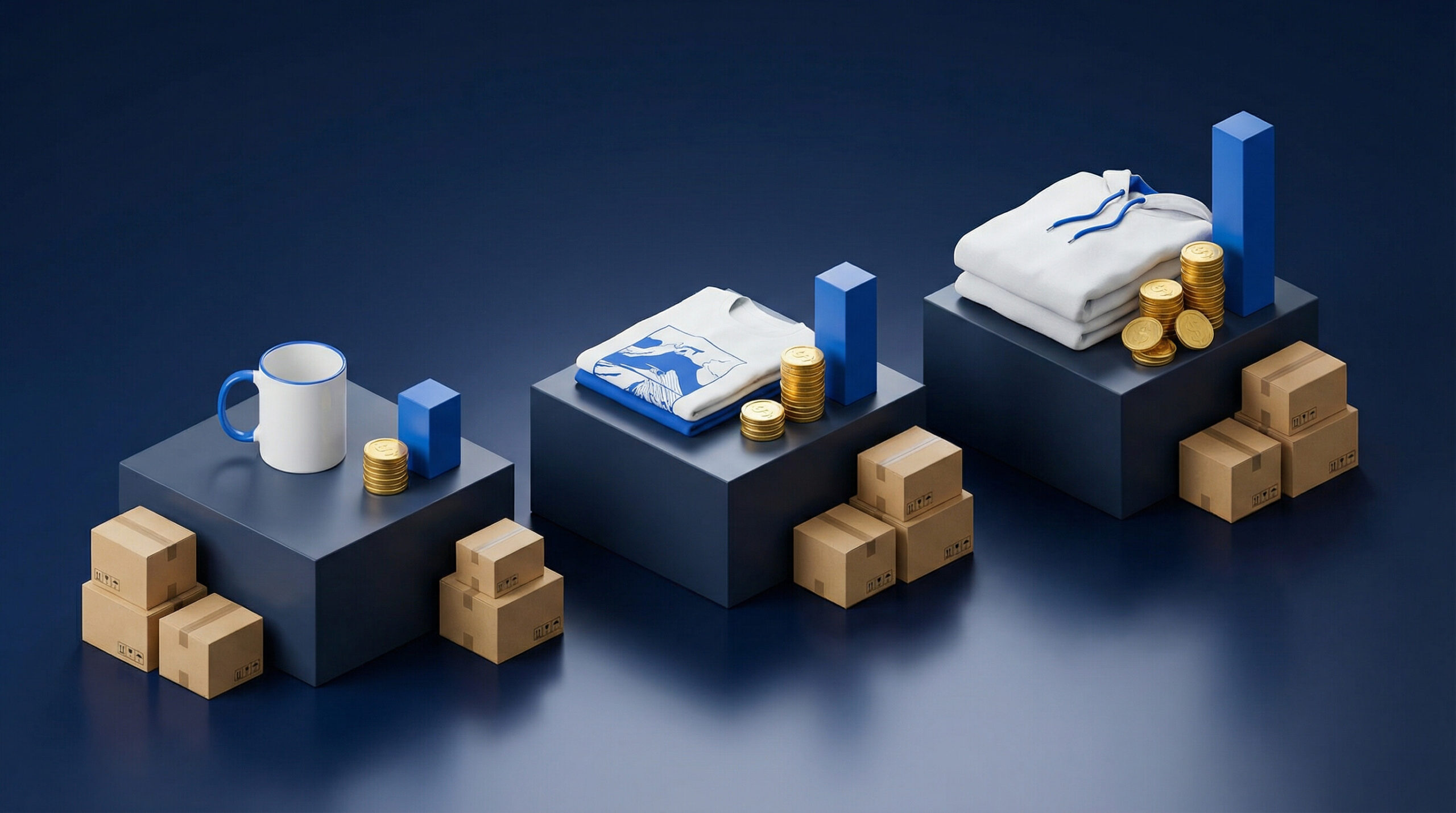
Let me show you the kind of math I would use for an Etsy shop. These are example numbers for a US-based seller using Etsy Payments and a typical print provider cost structure.
Three sample product breakdowns
| Product | Revenue | All-in Cost | Net Profit | Net Margin |
|---|---|---|---|---|
| Classic t-shirt | $34.98 | $25.52 | $9.46 | 27.0% |
| Ceramic mug | $29.98 | $22.84 | $7.14 | 23.8% |
| Personalized sweatshirt | $50.98 | $35.29 | $15.69 | 30.8% |
The sweatshirt is the one I like here. Not because the percentage is magically higher, but because the dollars left after the sale are more meaningful. You can absorb more volatility and still keep the business healthy.
This is why I generally prefer higher perceived value products over low-ticket commodity products. You can see that strategy show up in our Digital Products to Sell on Etsy article too. The best businesses are rarely built on the cheapest item in the market.
What happens when ads hit the order
Here is the part sellers hate. If an order carries extra ad cost, your margin can fall fast.
Take that $9.46 t-shirt profit example. Add a few dollars of ad cost, a discount, or one shipping miscalculation, and you are suddenly sitting near 15% net margin. That is why I never trust margin math that does not include a protection buffer.
Read Etsy’s current ad documentation too. Offsite Ads and marketplace advertising can materially change what you keep on an order, especially if you are already pricing thin.
What is a good POD margin really?
I think most generic advice on this topic is too soft.
People will tell you that 20% to 40% is a good print on demand profit margin. Technically that is true. Practically, it is incomplete. A 20% margin on a low-priced product can still leave you with almost no room to operate.
Beginner margin vs sustainable margin
If you are starting from zero, I would rather see you at 20% to 25% net on a product that actually sells than chasing a fantasy 50% margin on something nobody wants.
But once you have any traction at all, I want you moving toward 25% to 35% net. That is the range where a shop usually starts feeling stable instead of fragile.
For premium, personalized, or giftable products, I want even more. Buyers will pay for emotional value. That is the opportunity.
Why dollars per order matter more than percentages
This is one of those places where I disagree with a lot of surface-level advice. Sellers get obsessed with the percentage and ignore the cash.
A 40% margin on a cheap product can still leave you with less profit than a 28% margin on a premium product. Because of that, I often choose the product with better profit dollars per order, not just the prettier percentage.
That is one reason I like building around stronger product catalogs and faster testing loops. When you can explore more SKUs through something like MyDesigns Product Catalog and push them live fast, you stop betting the business on a single low-ticket bestseller.
You do not need more theory here. You need a workflow that turns ideas into listings while the opportunity is still alive.
The advantage usually goes to the sellers who can create, organize, and publish without getting buried in manual work.
Products with better margins than basic tees

If you want healthier POD margins, I would stop defaulting to basic shirts as the center of the store.
They can work. I am not anti-shirt. I am anti-blindly copying the most crowded product category on the internet.
Why personalized products usually win
Personalized products often outperform on margin because buyers compare them emotionally, not mathematically. A customized gift, memorial item, or niche-specific design is harder to price-shop.
That is where you can earn real breathing room. Less pure commodity pressure. Better willingness to pay. More margin left after fees.
If personalization is part of your strategy, I would look hard at Product Personalization and Multi-Product Publishing. The faster you can test personalized variations, the faster you learn which offers actually deserve scale.
The product traits I look for first
These are the traits I like most when margin matters:
- Giftability – birthdays, weddings, memorials, niche communities
- Perceived premium value – embroidery, heavier garments, bundles, personalization
- Lower direct comparison pressure – not the exact same generic shirt every other seller has
- Room for brand storytelling – products that feel curated, not interchangeable
If you want more category inspiration, our Best Print on Demand Sites and How to Sell on Etsy guides are a good next stop.
The biggest profit killers in POD

Most shops do not fail because POD cannot work. They fail because the margin model was weak from day one.
Pricing from base cost only
This is mistake number one. Sellers see a $10 product cost and think charging $19.99 leaves plenty of profit. It does not.
When all the extra costs land, that price can turn into a stress test. I strongly advise you to price from fully loaded cost, not just product cost.
Trying to win with lower prices
The old Etsy playbook said undercut everybody and make it up with volume. I think that playbook is cooked.
Etsy is more competitive, ads are more expensive, and buyers have more choices. Lower pricing rarely creates a durable advantage now. It just trains you to operate with no cushion.
The better move is to improve perceived value. Better niche. Better design angle. Better listing creative. Better product choice. Better personalization. That is why I care so much about tools like Mockup Generator and Vision AI. They help you raise the quality ceiling instead of just lowering price.
Once you know what angle you want to pursue, speed matters more than another hour of hesitation.
If you want this strategy to actually turn into output, the workflow after the idea matters just as much as the idea itself.
How I would price a POD store today
If I were starting a print on demand shop from zero today, this would be my exact move.
My five-step pricing playbook
- Start with total landed cost. Include every fee, not just supplier cost.
- Set a minimum acceptable net margin. For most products, I want 25% net as a target and 20% as the floor.
- Benchmark against the market. Check Etsy pricing, but do not copy the cheapest seller.
- Test perceived value before lowering price. Improve mockups, listing copy, and product selection first.
- Reprice in batches. Treat pricing like a system, not a one-time decision.
I also like separating products into three buckets:
- Traffic products that get clicks
- Profit products that actually make money
- Anchor products that raise average order value or brand perception
Most people overbuild traffic products and underbuild profit products. That is backwards.
Why automation protects margin
Here is the thing nobody talks about enough: margin discipline breaks when your workflow is messy.
If you are manually editing listings, manually checking supplier costs, and manually testing price points one by one, you move too slowly to protect your margin. This exact bottleneck is why we built workflows like Import & Sync, Shops & Integrations, and pricing plans built for real catalog scale in MyDesigns. Once you have dozens or hundreds of listings live, margin management stops being theory. It becomes an operations problem.
Why the old POD playbook is dead
I will end with the contrarian take.
The biggest edge in print on demand is not creativity by itself. It is not even niche selection by itself. The real edge now is leverage.
The sellers who win are not the ones making random cheap uploads and hoping something sticks. They are the ones who test faster, price cleaner, package value better, and kill weak-margin products before those products eat months of effort.
That is the game in 2026. Not more listings for the sake of more listings. Better economics. Better systems. Better decisions.
Frequently Asked Questions
+ Is print on demand profitable in 2026?
Yes, print on demand is still profitable in 2026, but only if you manage pricing, fees, and product selection carefully. Sellers who ignore shipping, Etsy fees, and ad costs usually overestimate how much they are really keeping.
+ What is a good print on demand profit margin?
A good print on demand profit margin is usually 20% to 35% net. Premium or personalized products can do better, while low-ticket commodity items often fall below that range once all costs are included.
+ How do you calculate print on demand profit margin?
Calculate net profit first by subtracting all costs from total order revenue, then divide net profit by total revenue and multiply by 100. Total costs should include product cost, shipping, platform fees, payment processing, listing fees, ad spend, and a small issue buffer.
+ Why are my Etsy profit margins so low?
Etsy profit margins are usually low because sellers forget to price in listing fees, transaction fees, payment processing, shipping, and advertising. Thin margins also happen when you compete on price instead of perceived value.
+ Which print on demand products usually have the best margins?
Products with better margins usually have stronger perceived value, less direct price competition, or some personalization built in. Premium apparel, personalized gifts, bundles, and niche products often outperform generic low-ticket items.


