


Etsy SEO is still one of the biggest make-or-break factors in whether your shop gets traffic or disappears into page 27. I have seen talented sellers blame the algorithm, blame saturation, and blame bad luck when the real issue was simpler: their listings were never built to be found in the first place.
If you want to know what is Etsy SEO, how it works in 2026, and how to improve Etsy SEO without wasting weeks on bad advice, this is the playbook I would follow.
I am going to keep this practical. No vague theory. No recycled fluff. Just the exact way I think about search visibility on Etsy today.
Key Takeaways
- Etsy SEO starts with buyer intent – if your title, tags, and imagery do not match what shoppers are actually searching for, your listing will struggle no matter how good the product is.
- Clicks and conversions matter after indexing – getting found is step one, but Etsy keeps rewarding listings that earn clicks, favorites, and sales.
- Relevance beats stuffing – the best Etsy SEO optimization is clear, specific phrasing that matches search intent, not awkward keyword repetition.
- Systems beat guesswork – sellers who organize keyword research, test thumbnails, and optimize listings in batches usually win faster than sellers tweaking one line at a time.
Table of Contents
- What is Etsy SEO, really?
- How Etsy SEO works in 2026
- Keyword research for Etsy SEO that actually helps
- How to optimize your Etsy listing without sounding robotic
- Etsy SEO tips that move the needle fastest
- Common Etsy SEO mistakes I see constantly
- The new advantage is speed and systems
- My simple Etsy SEO plan for the next 30 days
- Frequently Asked Questions
What is Etsy SEO, really?
What is Etsy SEO? At the simplest level, it is the process of helping Etsy understand what you sell so the platform can show your listing to the right buyer at the right moment.
That sounds obvious. But most bad Etsy SEO starts when sellers treat it like a trick instead of a communication problem. The goal is not to outsmart search. The goal is to make your listing extremely easy for Etsy to categorize and extremely appealing for a buyer to click.
Etsy search has two jobs
When I look at Etsy search, I think of it doing two things at once:
- Matching relevance – identifying listings connected to the shopper’s query
- Ranking performance – deciding which relevant listings are most likely to earn engagement and sales
Etsy has explained parts of this in its own guidance around Etsy Search visibility, and the platform has been pretty consistent on the fundamentals. Relevance gets you in the game. Buyer response helps determine how high you climb.
Why most sellers get this wrong
Here is the contrarian take: a lot of Etsy SEO advice is too obsessed with tags and not obsessed enough with market fit.
I have seen shops rewrite tags ten times while ignoring the fact that their thumbnail looked weak, the product angle was generic, or the title targeted a phrase buyers would never actually type. If your product does not earn the click, your SEO ceiling drops fast.

The sellers who win on Etsy usually move faster than the ones still polishing drafts.
This is exactly where a cleaner workflow starts to matter more than another round of planning.
How Etsy SEO works in 2026
The old playbook was simpler. Stuff the strongest keywords into your title, fill all your tags, and hope volume does the rest. In 2026, Etsy SEO is more feedback-driven than that. The marketplace is crowded, so the algorithm needs better signals.
Relevance is the entry ticket
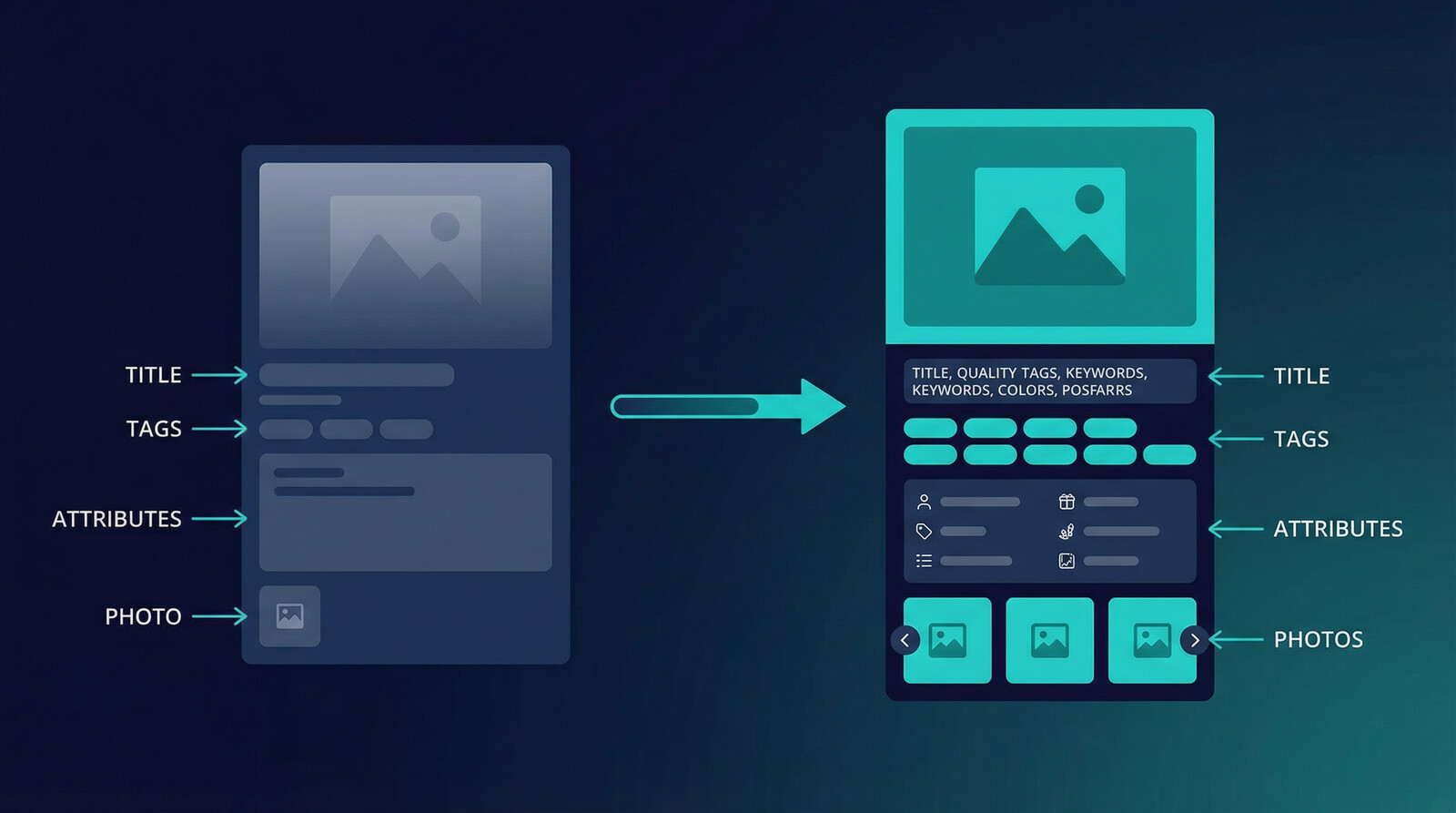
Your query match still comes from the basics: titles, tags, categories, attributes, and listing context. Etsy says categories and attributes act like extra tags, which is why proper listing setup matters so much. You can read more in Etsy’s help content on attributes and listing edits.
If you sell a funny cat mug and your listing says “cute coffee cup gift for animal lover,” Etsy may partially understand it. If your listing clearly targets “funny cat mug,” “cat lover gift,” and “ceramic cat coffee mug,” your relevance picture sharpens.
Performance signals decide momentum
Once a listing is eligible, Etsy starts watching what shoppers do. Do they click? Favorite? Buy? Bounce? Ignore?
This is why thumbnail quality and offer clarity are part of Etsy SEO, whether some people like that framing or not. Search visibility is tied to buyer behavior. A listing with decent keyword targeting and strong click-through often outranks a better-keyworded listing with weak shopper response.
I would also pay attention to shop-level trust. Reviews, fulfillment reliability, and customer experience all shape how much confidence Etsy has in sending traffic your way. Etsy’s own seller resources around customer service and shop quality reinforce that point.
Keyword research for Etsy SEO that actually helps
If you skip keyword research, you are guessing. If you overcomplicate keyword research, you are procrastinating. The sweet spot is simple: figure out how buyers describe the product, then organize those phrases by intent.
Start with buyer language
I like starting with Etsy autocomplete, related searches, and listing patterns I can observe directly. Search your seed term on Etsy and watch the phrasing that repeats. Those repeated patterns are telling you how real buyers think.
Then break keywords into buckets:
- Primary keyword – your clearest core phrase, like “etsy seo” for this topic or “custom teacher shirt” for a product
- Secondary descriptive phrases – long-tail versions, use cases, styles, audience modifiers
- Intent modifiers – gift, personalized, printable, digital download, wedding, nursery, etc.
This matters because buyers rarely search like marketers. They search like buyers with a specific need.
Use Etsy SEO tools the right way
There are plenty of etsy seo tools that can speed up research, but most sellers use them backward. They chase the highest-volume keyword and ignore the fact that broad keywords are often the hardest to convert.
I would rather rank for a phrase with obvious purchase intent than collect impressions from a vague term that brings low-quality traffic.
Use tools to:
- spot keyword variations you missed
- understand competition density
- find title structures that appear repeatedly
- build clusters of related terms for multiple listings
Use Etsy’s own guidance too. The seller handbook is not perfect, but it does show how Etsy wants sellers to think about discoverability.

How to optimize your Etsy listing without sounding robotic
This is the part most people mean when they say etsy seo optimization. And yes, the mechanics matter. But the best listing copy still has to sound natural enough for a human to trust it.
Write titles for humans and search
Your first few words matter a lot. Put the clearest phrase first, then expand into useful modifiers that still sound readable.
Bad title example:
Funny Mug Cat Mug Mug for Cat Lover Coffee Mug Gift Mug Cute Mug
Better title example:
Funny Cat Mug for Cat Lovers, Ceramic Coffee Cup Gift, Cute Pet Owner Present
The second version still gives Etsy context, but it also gives the buyer confidence. That matters.
Make tags, attributes, and categories work together
Do not waste tags repeating identical phrasing in lazy ways. Use them to cover closely related intent. If your title already signals the core product, your tags can expand context around audience, occasion, style, and use case.
- Choose the most accurate category possible
- Fill in every relevant attribute
- Use all tag slots thoughtfully
- Avoid duplicate wording that adds no new signal
If you are building lots of listings, organize these elements in a spreadsheet or a listing system. This is exactly why we built bulk workflows inside bulk publishing in MyDesigns. When you can standardize titles, tags, and attributes across a batch, you make fewer sloppy mistakes.
Descriptions and photos still matter
Some sellers still ask if descriptions matter for Etsy SEO. My answer is yes, but not in the simplistic way people mean it. Your description helps clarify the product, answer objections, and increase conversion rate. Better conversion rate supports better search performance over time.
Photos matter even more. Your lead image is basically your ad creative inside search results. If it is cluttered, dim, or confusing, your Etsy SEO suffers even if your keywords are solid.
For image quality, listing consistency, and faster creative testing, I would also look at tools that help you build mockups and variations at scale. That is one of the reasons sellers use listing management workflows and our Dream AI workflow when they want more options without more manual work.
You do not need more theory here. You need a workflow that turns ideas into listings while the opportunity is still alive.
The advantage usually goes to the sellers who can create, organize, and publish without getting buried in manual work.
Etsy SEO tips that move the needle fastest
There are a hundred Etsy SEO tips floating around online. Most are either too basic to matter or too tiny to justify your time. These are the ones I think punch above their weight.
Fix near-miss listings first
If a listing already gets impressions but not enough clicks or sales, start there. That listing has signal. It is closer to winning than the listing with zero data.
When I audit shops, I usually prioritize:
- listings with impressions but weak click-through
- listings with favorites but low conversion
- listings ranking for the wrong keyword intent
- older listings with strong products but outdated thumbnails
This is faster than endlessly creating new listings while ignoring underperforming assets that are one good update away from traction.
Batch testing beats random editing
I strongly prefer batch changes over random one-off edits. Test 10 to 20 similar listings with a stronger title format. Test a new lead image style across a collection. Test a cleaner keyword map for one niche.
I watched one seller go from flat traffic to a clear upward trend after we cleaned up 60 listings in one weekend. Not because of a magic hack. Because the entire shop finally sent a more consistent relevance signal.
That is the part people miss. Etsy likes clarity.
Common Etsy SEO mistakes I see constantly
- Chasing broad keywords too early – if your shop is small, specific phrases usually give you a better shot.
- Writing titles for the algorithm only – if humans will not click it, the algorithm will stop caring too.
- Using weak first images – low click-through quietly kills rankings.
- Ignoring listing intent – “gift for mom” and “funny nurse mug” are different search moments.
- Editing without a plan – if you change everything constantly, you learn nothing.
- Building too few listings – one great listing can win, but most shops grow faster with a portfolio of tightly targeted listings.
Etsy also gives sellers direct guidance on improving discoverability and listing quality through its support resources, including pages on how Etsy search works and shop optimization basics. I would pay attention to those before listening to random algorithm theories on YouTube.

Once you know what angle you want to pursue, speed matters more than another hour of hesitation.
If you want this strategy to actually turn into output, the workflow after the idea matters just as much as the idea itself.
The new advantage is speed and systems
The real edge in 2026 is not just creativity. It is operational speed.
That means faster research. Faster listing creation. Faster image testing. Faster optimization cycles. The sellers who can launch, observe, and refine at scale have a real advantage over sellers doing everything manually.
This is where I think the old Etsy playbook starts breaking down. The advice built for a shop with 20 handcrafted listings is not enough for sellers trying to build serious volume across proven niches.
Where MyDesigns fits if you want scale
If you are optimizing a handful of listings, a spreadsheet may be enough. If you are trying to build a real catalog, you need systems.
That is why we built tools for bulk creation, design variation, mockups, and publishing workflows inside MyDesigns. Not to replace strategy. To remove bottlenecks. You can also explore our free signup if you want to test the workflow for yourself.
Soft truth: manual work feels productive right up until it becomes the thing capping your growth.
My simple Etsy SEO plan for the next 30 days
If I were rebuilding an Etsy shop from scratch today, this would be my exact move:
- Pick one niche cluster and define the buyer intent behind it.
- Research 30 to 50 keyword variations from Etsy autocomplete, top listings, and trusted Etsy SEO tools.
- Create a keyword map so each listing targets a distinct phrase set instead of cannibalizing the others.
- Rewrite titles, tags, and attributes for your best 20 opportunities first.
- Upgrade lead images so they earn stronger clicks inside search.
- Watch impressions, clicks, favorites, and sales for two to four weeks.
- Double down on winners and expand adjacent variations.
I get why sellers want a shortcut here. Etsy SEO can feel frustrating because feedback is delayed and results are uneven. But once you stop treating each listing like an isolated experiment and start treating your shop like a search system, things get a lot clearer.
Do that long enough and Etsy starts understanding exactly who to show your products to.
Frequently Asked Questions
+What is Etsy SEO in simple terms?
Etsy SEO is the process of helping Etsy understand and rank your listing for relevant shopper searches. It includes your title, tags, categories, attributes, images, and how buyers respond once they see your listing.
+How long does Etsy SEO take to work?
Etsy SEO can start shifting visibility within days, but meaningful performance trends usually take a few weeks. The timeline depends on competition, listing quality, buyer demand, and whether your updates improve click-through and conversion.
+Do Etsy descriptions matter for SEO?
Yes, Etsy descriptions matter because they help clarify your product and improve conversion. Even if descriptions are not the strongest ranking factor by themselves, better buyer understanding often leads to better performance signals.
+What are the best Etsy SEO tools?
The best Etsy SEO tools are the ones that help you uncover keyword variations, competition patterns, and listing opportunities quickly. I would use them to support decision-making, not to replace common sense about buyer intent and product quality.
+How do I improve Etsy SEO without starting over?
Start with listings that already have impressions, then improve titles, tags, attributes, and lead images in a structured way. That is usually the fastest path if you want to know how to improve Etsy SEO without rebuilding your whole shop.


Leave a Reply