


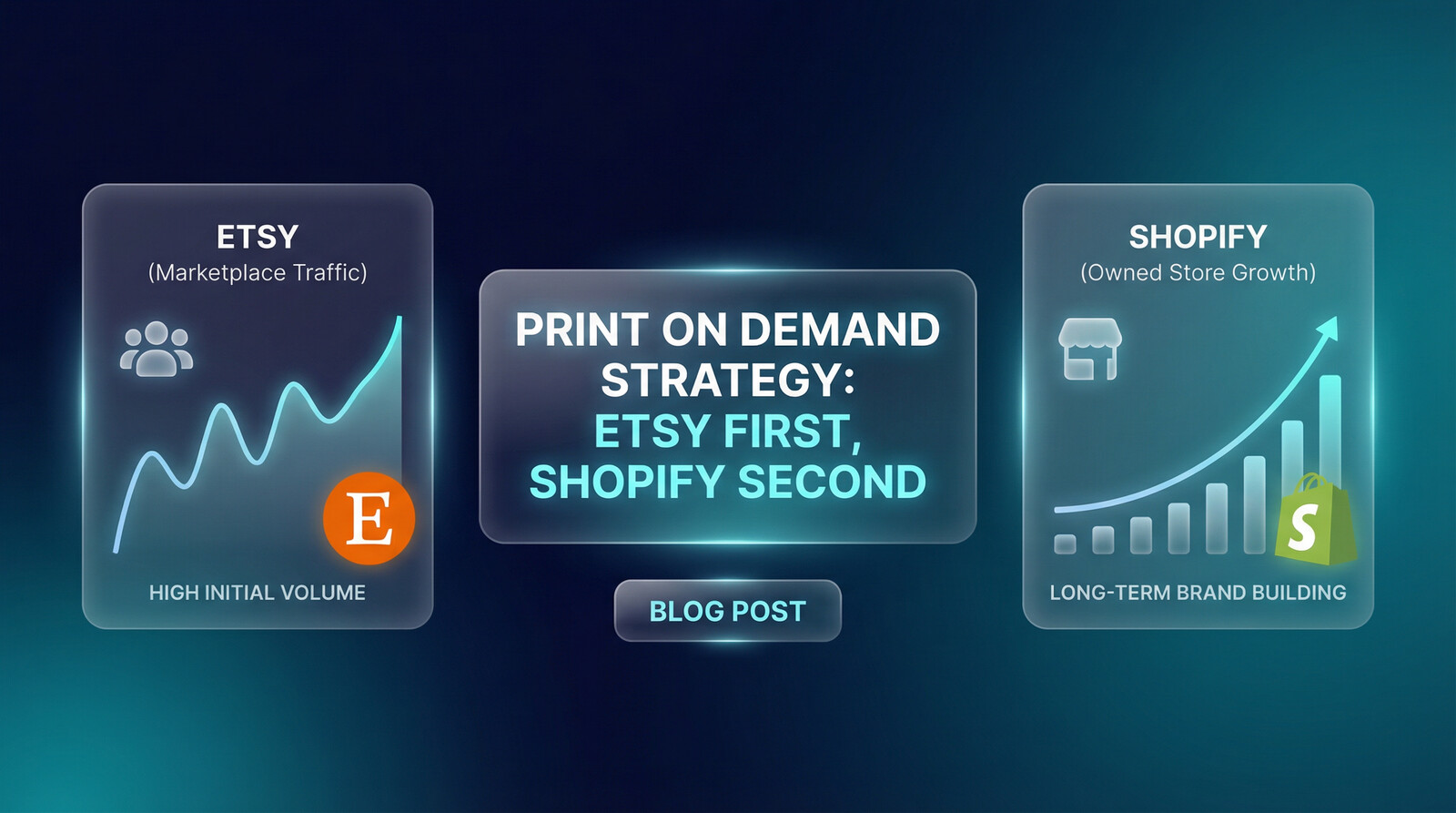
If you are trying to decide between Etsy and Shopify for print on demand, here is my blunt answer: Etsy is the faster place to validate demand, and Shopify is the better place to build a real business. That is the core of the Etsy vs Shopify print on demand debate. Most people get stuck because they treat it like an either-or decision when the smartest move is usually sequencing.
I have watched sellers waste months building a gorgeous Shopify store with no proof customers wanted the products. I have also watched sellers build solid Etsy revenue and then hit a ceiling because they never owned the customer relationship, never built a brand, and never improved margins. Both platforms can work. They just solve different problems at different stages.
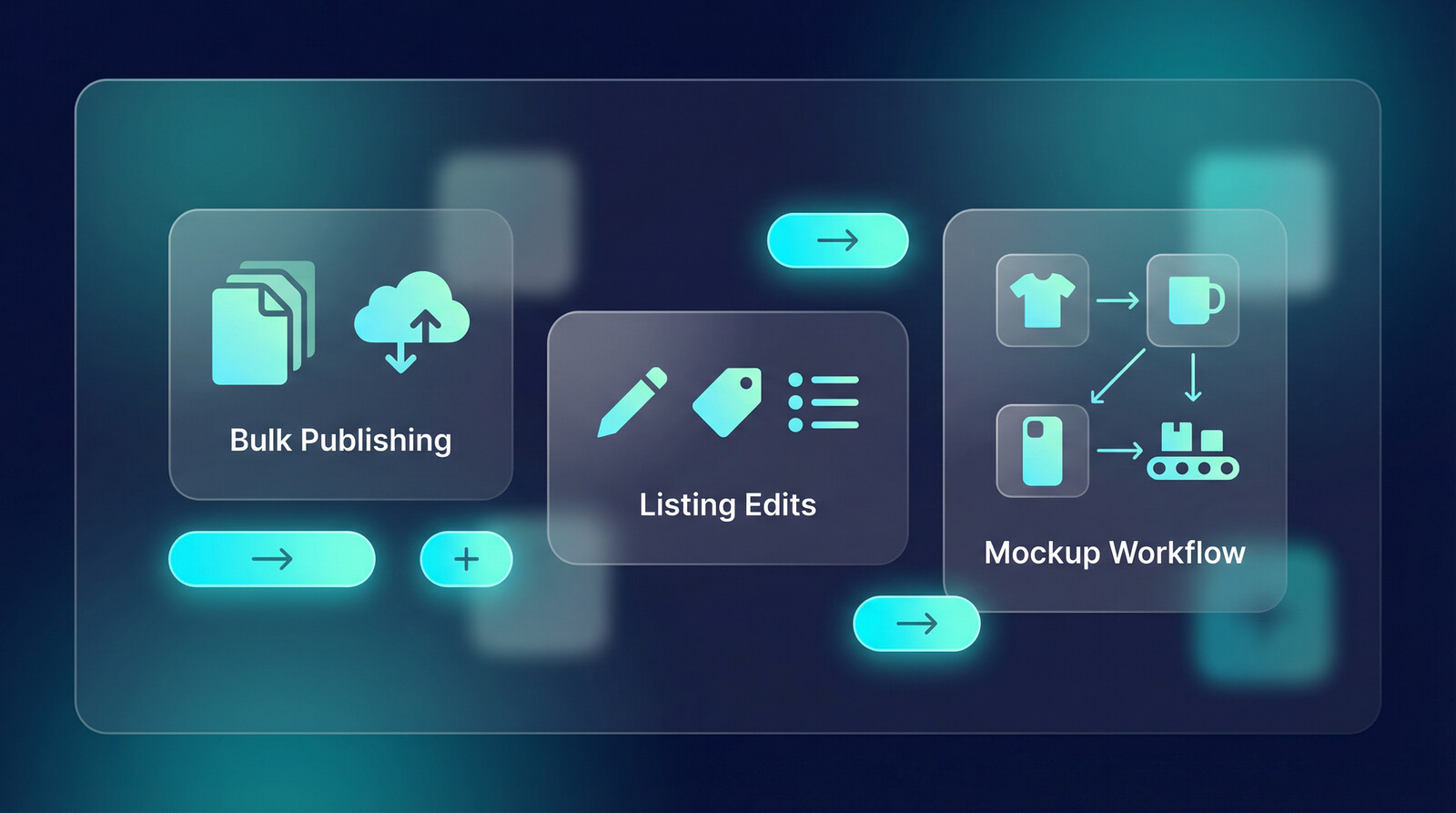
If I were starting from zero today, I would use Etsy to test product-market fit fast, then move the winners into a Shopify store once the demand is obvious. And if you plan to run both without drowning in uploads, mockups, and listing edits, you need a system for multi-product publishing, listing management, and mockup production that does not eat your week.
Key Takeaways
- Etsy is the better validation platform – You can get in front of existing buyers faster without building traffic from scratch.
- Shopify is the better ownership platform – You control the brand, customer journey, pricing, and long-term margin structure.
- The best strategy for most serious sellers is Etsy first, Shopify second – Prove demand, then migrate winning products into an owned storefront.
- Operational complexity is what breaks most sellers – Publishing, mockups, syncing, and listing updates get messy fast unless you standardize the workflow.
Table of Contents
- Why Most Sellers Pick the Wrong Platform First
- Etsy Wins When You Need Proof Fast
- Shopify Wins When You Want a Real Asset
- Etsy vs Shopify Print on Demand Costs and Margins
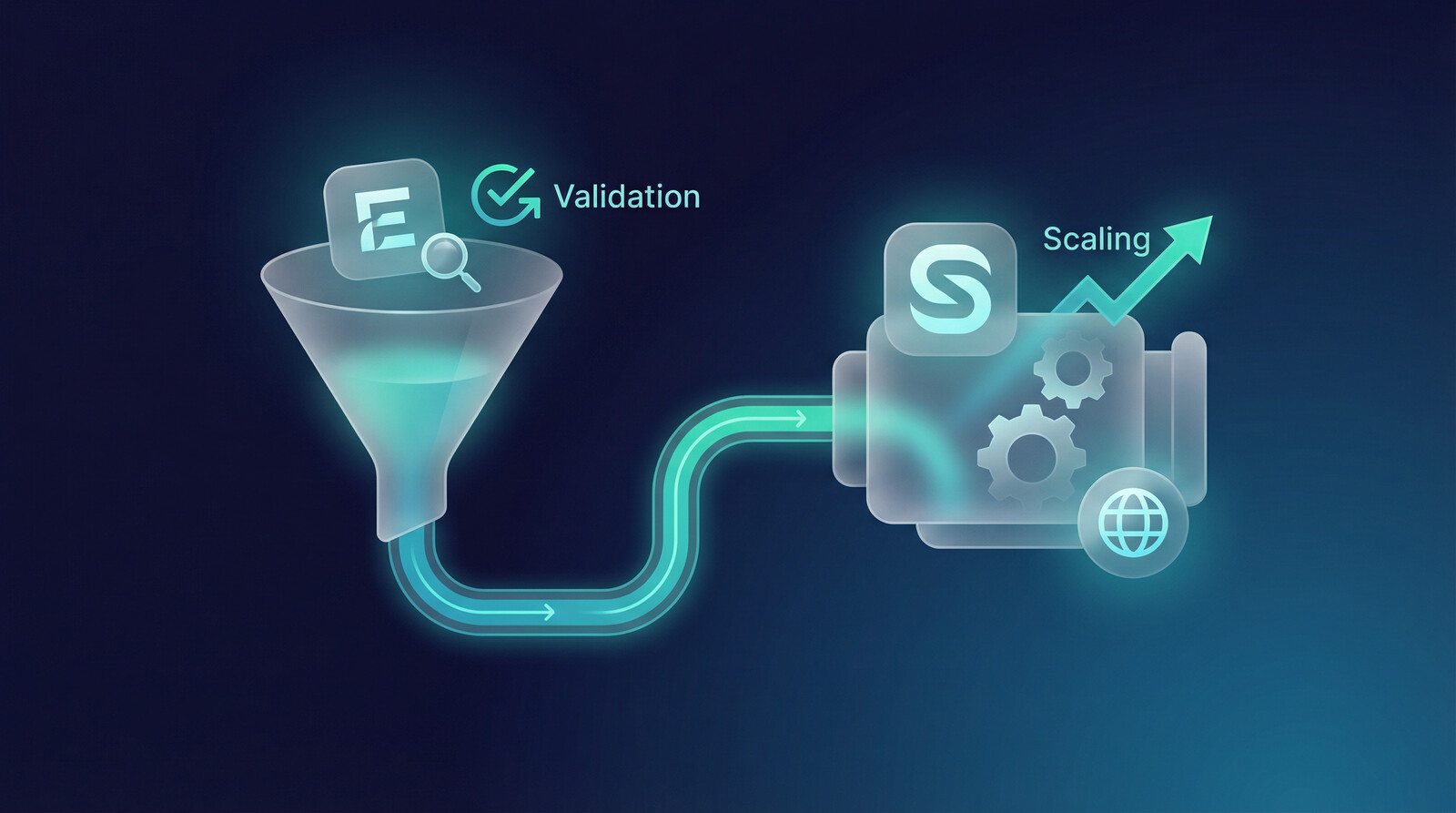
- The Best Playbook: Etsy First, Shopify Second
- The Operations Stack You Need Before You Scale
- Mistakes That Keep Sellers Small
- Frequently Asked Questions
- My Final Take on Etsy vs Shopify Print on Demand
Why Most Sellers Pick the Wrong Platform First
The biggest mistake I see in the Etsy vs Shopify print on demand conversation is that people pick based on identity, not economics. They want to feel like a brand owner, so they start on Shopify. Or they want fast sales, so they stay on Etsy forever. Neither mindset is complete.
Your first job is not to look legit. Your first job is to find out whether strangers will pay for your product. That means speed matters. Data matters. Feedback loops matter. You need to know which designs get clicks, which mockups convert, and which niches are dead on arrival.
The Real Question Is Speed vs Control
Etsy gives you speed because the marketplace already has buyer intent. People are on Etsy looking for gifts, niche apparel, personalized products, and impulse purchases. Shopify gives you control because it is your store, your customer list, your checkout flow, and your brand experience. Those are not interchangeable benefits.
According to Etsy’s Seller Handbook, sellers are stepping into a marketplace built around product discovery. According to Shopify’s pricing and platform model, you are paying for infrastructure, flexibility, and ownership. One is demand access. The other is business infrastructure.
What Beginners Get Backwards
Beginners usually assume the platform with more features is automatically the better choice. I do not agree. The better choice is the platform that answers your biggest current bottleneck. If your bottleneck is no traffic, Etsy usually wins. If your bottleneck is no control, weak repeat purchase systems, or squeezed margins, Shopify starts winning.
I have seen sellers spend two weeks obsessing over font pairings and homepage sections on a new Shopify store with zero validated products. That is just procrastination wearing a business costume.
The sellers who win on Etsy usually move faster than the ones still polishing drafts.
This is exactly where a cleaner workflow starts to matter more than another round of planning.
Etsy Wins When You Need Proof Fast
If you are new to print on demand, Etsy is usually the right place to start. Not because it is perfect. Because it gets you to signal faster. You can create listings, get indexed inside a buying marketplace, and learn what resonates without building a full ecommerce machine.
Etsy also matches how many POD products are bought. Plenty of buyers are not looking to join a brand movement. They just want a funny mug for a nurse, a custom dog sweatshirt, or a last-minute gift that feels personal.
Etsy Traffic Is the Big Advantage
The biggest advantage Etsy has is built-in discovery. The platform already attracts massive shopping intent, and sellers can benefit from that demand without mastering paid ads on day one. Etsy publishes its own guidance around search visibility and listing quality through the Etsy search documentation, and the game is pretty straightforward: relevant keywords, strong thumbnails, competitive pricing, clean shipping expectations, and enough listings to create surface area.
That last part matters more than people think. Serious sellers do not win with one design and a dream. They win by testing angles, niches, and offer variations at volume. That is exactly why we built bulk publish into MyDesigns. Once you start pushing lots of product variants, doing it one by one feels ridiculous.
Where Etsy Starts to Hurt
Etsy gets painful the moment you want real ownership. You do not fully control the customer relationship. You cannot shape the onsite experience the same way you can with Shopify. You are competing beside lookalike products. Your store page is not really a brand environment. It is a rented shelf.
Etsy also makes it easy to confuse marketplace momentum with business durability. A seller can do well for months, then get hit by copycats, shifts in search placement, fee pressure, or policy friction. You can absolutely make money there. I just would not build my entire future on a platform where I do not own the lane.
If your goal is simply to get your first sales, Etsy is great. If your goal is to build an asset you can compound for years, Etsy alone is not enough.
Shopify Wins When You Want a Real Asset
Shopify is where you go when you are done borrowing traffic and ready to build something you actually own. In the Etsy vs Shopify print on demand decision, Shopify wins on brand, data, customer experience, upsells, bundles, subscriptions, email capture, and long-term margin control.
That matters because the old print on demand playbook is getting weaker. Throwing random designs into a marketplace and hoping for organic sales is not a strategy anymore. The sellers who keep winning are the ones building systems, audiences, and repeatable offers.
Shopify Gives You Brand Control
With Shopify, you own the storefront and the journey. You can position a niche brand clearly, bundle products, build an email list, run abandoned cart flows, improve average order value, and drive traffic from channels Etsy does not own. Shopify’s own documentation around store customization and order and app workflows points to the real advantage: flexibility.
And once you have more than a handful of winning products, flexibility is not a luxury. It is the difference between staying small and building a brand customers remember.
Shopify Is Not Easier. It Is More Powerful
Let me be clear: Shopify is not the easier path. You have to drive traffic. You have to manage conversion rate. You have to make your landing pages, offers, and email flows work. This is why I rarely tell true beginners to start there first.
But once a product proves itself, Shopify becomes the obvious next move. You can create a cleaner brand story, launch collections, control merchandising, and reduce the operational drag of maintaining a growing catalog across channels.

Etsy vs Shopify Print on Demand Costs and Margins
People obsess over platform fees, but the bigger issue is margin control. Fees matter, yes. But a platform that lets you lift average order value by 20 percent is usually more powerful than a platform that saves you a few dollars in monthly software costs.
Cost Comparison Table
| Factor | Etsy | Shopify |
|---|---|---|
| Upfront setup friction | Low | Moderate |
| Monthly platform cost | No standard monthly subscription required to start, but transaction and listing fees apply | Monthly subscription required. Shopify plan pricing is listed on the official pricing page |
| Traffic source | Marketplace discovery | You generate it through SEO, email, social, and paid traffic |
| Brand control | Limited | High |
| Customer ownership | Restricted compared with owned store channels | High |
| Upsells and bundles | Limited | Strong |
| Best use case | Fast validation and early sales | Brand building and scale |
For the specifics, Etsy breaks down seller fees on its official fee page, and Shopify lays out subscriptions on its official pricing page. Compare them, but do not stop there.
Margin Control Matters More Than Fees
Here is the contrarian take: most sellers do not have a fee problem. They have a weak-offer problem and an operations problem. If your mockups are bland, your niche is too broad, and your catalog is messy, shaving a few points off fees will not save you.
Shopify tends to win on margin expansion because you can control bundling, post-purchase offers, and branded repeat purchase flows. Etsy tends to win on lower initial friction because you can plug into existing buyer demand faster. Different stage, different math.
If you want better economics on either platform, clean up your workflow first. Use better mockups through Product Mockups, and stop rebuilding listings from scratch every time you test a new product angle.
You do not need more theory here. You need a workflow that turns ideas into listings while the opportunity is still alive.
The advantage usually goes to the sellers who can create, organize, and publish without getting buried in manual work.
The Best Playbook: Etsy First, Shopify Second
This is the path I would recommend to most serious sellers. Not hobbyists. Not people looking for a lucky hit. Sellers who want to build something durable.
Phase One: Validate on Etsy
Start by using Etsy to answer a simple question: what does the market actually want from you?
- Launch a focused niche, not a random general store
- Test multiple design angles and product formats
- Watch clicks, favorites, conversion rate, and which mockups earn attention
- Double down on winners and cut dead listings quickly
I watched one seller go from barely moving product to finding a real pocket of demand after switching from generic dog shirts to hyper-specific memorial pet designs. Same production model. Same basic product. Different positioning. The signal showed up on Etsy first because the marketplace exposed the niche faster.
Phase Two: Scale on Shopify
Once a product line proves itself, move the winners into Shopify and build the brand around them. Do not wait until Etsy starts slowing down. Move while the data is fresh and the customer feedback is obvious.
- Create a focused storefront around the proven niche
- Use better merchandising, bundles, and upsells
- Capture email and SMS where appropriate
- Drive repeat traffic back to owned channels
- Keep Etsy as an acquisition channel, not your only channel
This is also where a platform like MyDesigns for print on demand starts paying for itself operationally. Once you are managing multiple channels, listings, and product variations, the bottleneck is no longer ideas. It is execution speed.
The Operations Stack You Need Before You Scale
Most sellers think scaling means more products. It does not. Scaling means better systems. Without those, more products just create more chaos.
Manual Work Is the Hidden Tax
The hidden tax in print on demand is manual work. Uploading one listing is easy. Updating 80 listings after a title change is not. Rebuilding mockups for every color and angle is not. Syncing listings across Etsy and Shopify is definitely not.
This exact bottleneck is why we built tools like Image Utilities into the workflow. The serious advantage today is not creativity alone. It is output. The seller who can publish, test, iterate, and refine faster usually learns faster too.
What I Would Standardize Immediately
- Mockup templates by product type
- Naming conventions for niches, collections, and variants
- A repeatable listing framework for titles, bullets, and tags
- A single dashboard for listing edits and channel publishing
- A weekly review of top click-through and conversion performers
If you are still doing everything manually, do not confuse hard work with progress. You are probably just carrying operational debt.
Once you know what angle you want to pursue, speed matters more than another hour of hesitation.
If you want this strategy to actually turn into output, the workflow after the idea matters just as much as the idea itself.
Mistakes That Keep Sellers Small
If you want the short version, here it is: sellers stay small because they either chase traffic too early or avoid ownership too long.
- Starting on Shopify with no validated offer – beautiful store, no demand
- Staying only on Etsy forever – sales without ownership
- Testing too few products – not enough surface area for signal
- Ignoring mockup quality – weak presentation kills click-through
- Treating operations as an afterthought – scale collapses under manual workload
I get why people hesitate to branch out beyond Etsy. Building traffic sounds harder because it is harder. But harder and better are not the same thing. If you have proven products, Shopify gives you room to build a company, not just a shop.
And if you are still early, stop overcomplicating it. Start where the feedback is fastest, then graduate to the platform that gives you real control.
Frequently Asked Questions
+ Is Etsy or Shopify better for print on demand?
Etsy is usually better for validating print on demand products fast, while Shopify is better for building a long-term brand. If you are starting from scratch, Etsy often gets you demand signals faster. Once products prove themselves, Shopify gives you better ownership and margin control.
+ Should beginners start with Etsy or Shopify?
Most beginners should start with Etsy. It is easier to access buyer intent there without building traffic from zero. Shopify makes more sense after you already know which products and offers convert.
+ Can you sell print on demand on both Etsy and Shopify?
Yes, and that is often the smartest setup. Etsy can help you validate and acquire customers, while Shopify becomes your owned storefront for higher control and better long-term economics. The key is having a workflow that keeps listings, mockups, and product data organized across both channels.
+ Is Shopify more profitable than Etsy for print on demand?
Shopify can be more profitable once you have proven demand because you control the storefront, offers, and customer journey. Etsy can still be profitable, but you have less control over branding and retention. Profitability depends more on offer quality and operations than on platform fees alone.
+ What is the best Etsy vs Shopify print on demand strategy?
The best strategy for most sellers is Etsy first and Shopify second. Use Etsy to validate niches and products quickly, then move proven winners into Shopify so you can build a brand and improve margins. That gives you both speed and ownership instead of choosing one too early.
My Final Take on Etsy vs Shopify Print on Demand
If you force me to choose one starting platform for most sellers, I pick Etsy. If you force me to choose one end-state platform for a serious business, I pick Shopify. That is the cleanest answer I can give.
The best operators stop thinking in platform loyalty and start thinking in sequencing. Validate where demand already exists. Scale where ownership compounds. That is how you stop guessing and start building something real.


Leave a Reply