


If you want the most profitable print on demand products, stop chasing whatever is easiest to upload. Easy products usually attract the most sellers, the fastest race to the bottom, and the weakest margins.
I have seen this pattern over and over. Someone launches with generic tees, copies the same pricing everyone else uses, then wonders why they are working hard for $4 profit. The real money in POD comes from products with higher perceived value, lower design fatigue, and room for personalization or niche positioning.
In this guide, I am breaking down the 10 POD products I would prioritize in 2026 if margin mattered most. Not just what sells, but what leaves enough room after production, shipping, marketplace fees, and discounts to make the business worth building.
Key Takeaways
- The highest-margin POD products are usually not the cheapest to source – they are the ones buyers happily pay a premium for because they feel personal, giftable, or high value.
- Personalization beats commodity design – mugs, canvases, journals, and embroidered hats often outperform basic tees when your offer feels custom.
- Shipping and fee structure matter as much as base cost – a product with a lower production cost can still be less profitable if it is bulky, fragile, or fee-heavy.
- A narrow, smarter catalog usually wins in 2026 – 10 focused products with clean pricing logic will outperform 100 random listings almost every time.
Table of Contents
- Why most sellers misjudge profit
- What actually makes a POD product high margin
- Most profitable print on demand products: top 5
- Most profitable print on demand products: next 5
- Margin killers that erase profit
- Simple scorecard for choosing what to sell
- Why 2026 rewards smaller smarter catalogs
- Frequently Asked Questions
Why most sellers misjudge profit

Most beginners look at selling price minus base cost and call it profit. That is not profit. That is wishful thinking.
Real POD margin gets squeezed by marketplace fees, payment fees, shipping subsidies, refunds, discounting, and the fact that some products convert only when you make the price look lower than it should be. If you sell on Etsy, for example, you also need to account for listing, transaction, and payment fees, not just your print bill.
That is why I would rather sell a product with a $14 base cost and a believable $39 retail price than a product with a $7 base cost that stalls above $19. Margin lives in pricing power, not just low cost.
Revenue is not margin
I watched one seller pile up sales on basic unisex tees and still feel stuck because the net profit per order was barely enough to matter. Then they added personalized mugs and framed wall art into the same niche. Order volume stayed similar, but net profit per order jumped hard. Same store. Better product mix.
That is the game. You do not need the product with the biggest search volume. You need the one with the best relationship between conversion rate, perceived value, and total landed cost.
The hidden cost stack
Before you call a product profitable, run it through the full stack:
- Base production cost
- Shipping cost or shipping subsidy
- Marketplace fees such as Etsy seller fees
- Payment processing fees
- Packaging or breakage risk
- Expected discounting during promotions
- Refund and replacement rate
If you want a cleaner way to manage margin across multiple products, this is exactly where a workflow tool matters. Inside MyDesigns Listing Management, you can keep product variants, listing edits, and pricing updates organized instead of guessing product by product.
Better margins do not only come from pricing. They also come from a workflow that wastes less time and effort.
This is exactly where a cleaner workflow starts to matter more than another round of planning.
What actually makes a POD product high margin
The highest-margin POD products usually share four traits:
- They feel more valuable than they cost to make.
- They fit gifting or personalization.
- They are niche-friendly.
- They are not saturated with identical offers.
That last one matters more in 2026 than ever. The old playbook was simple: upload thousands of generic designs onto generic products and hope volume saves you. I do not buy that anymore. AI and bulk publishing made supply explode. Your edge now is not just making more listings. It is making better product bets.
My 2026 selection filter
If I were starting from zero today, every product would have to pass this filter:
- Can I get at least 55% gross margin before ads?
- Can I explain why someone would pay extra for this?
- Does personalization or niche specificity improve conversion?
- Can I create multiple variations fast?
- Is shipping reasonable for the retail price?
If the answer is no, I move on. Fast.
This is also why I like building around repeatable product systems. You can use Bulk Publish to test winning concepts faster without rebuilding your workflow every time.
Most profitable print on demand products: top 5
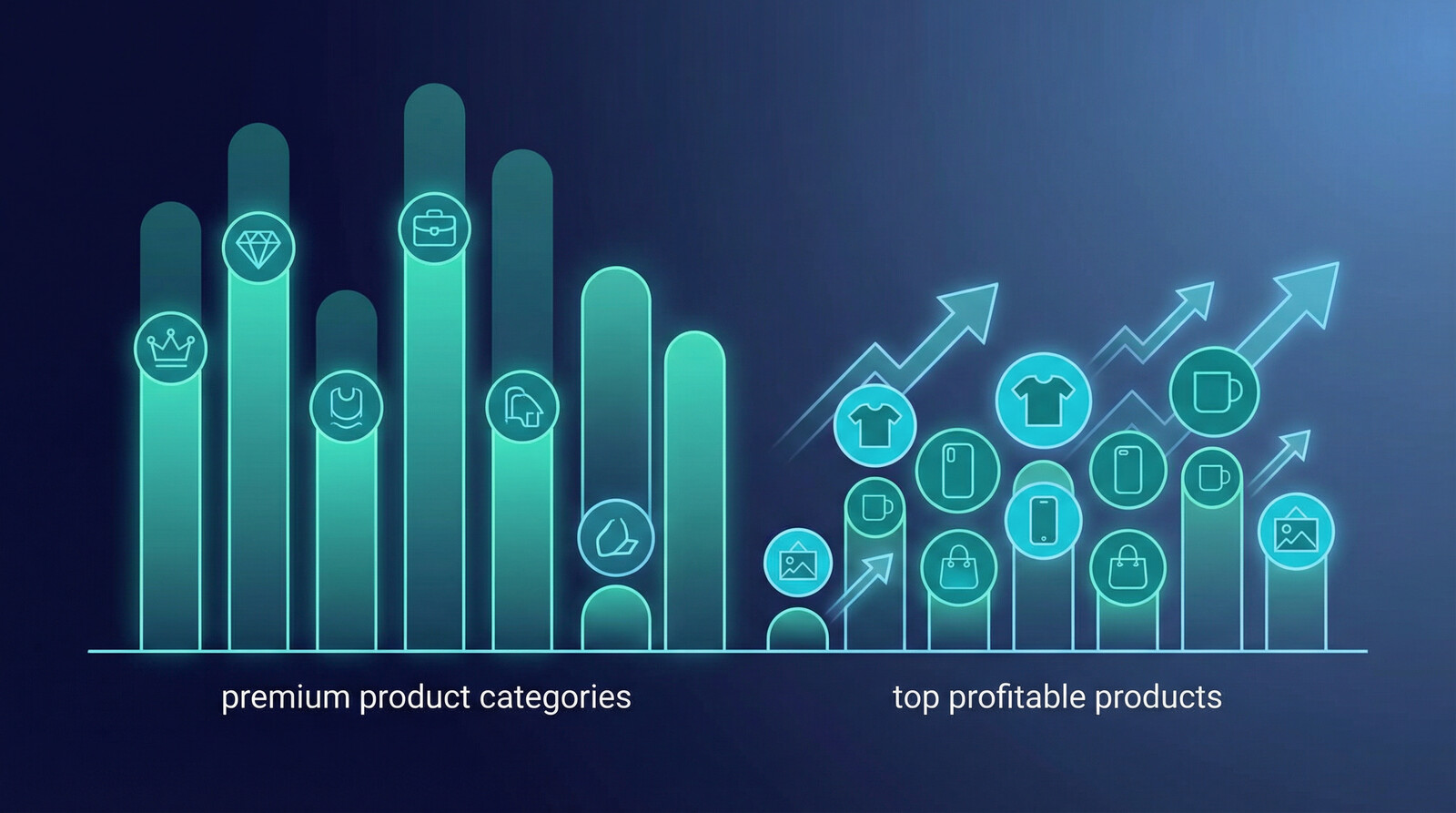
Here are the first five products I would prioritize for strong margin potential in 2026. The ranges below are realistic gross margin targets, not fantasy math. They assume decent design quality, thoughtful pricing, and a niche angle that gives you room to charge more.
| Product | Typical Base Cost | Typical Retail Range | Target Gross Margin | Why It Works |
|---|---|---|---|---|
| Premium oversized graphic tees | $11-$18 | $29-$42 | 50%-62% | Higher perceived value than commodity tees |
| Embroidered hats | $9-$16 | $28-$40 | 55%-65% | Strong niche identity and giftability |
| Personalized mugs and tumblers | $6-$14 | $19-$34 | 55%-70% | Daily-use product with gift appeal |
| Framed posters and canvas sets | $18-$45 | $49-$110 | 50%-68% | Big perceived value jump with framing or sets |
| Hardcover journals and planners | $8-$15 | $22-$38 | 55%-67% | Excellent for personalization and bundles |
1. Premium oversized graphic tees
Basic tees are crowded. Premium oversized tees are a different story. When the fabric weight, fit, and branding feel intentional, buyers stop comparing your listing to the cheapest shirt on the page.
I like these when your niche has strong identity attached to it: gym culture, faith, trades, pets, moms, fishing, motorsports. The margin range is not the absolute highest on this list, but the volume potential is huge if you avoid generic design language.
2. Embroidered hats
Hats punch above their weight because embroidery signals quality. People expect to pay more. That matters.
If your niche works well with short phrases, icons, initials, or understated branding, hats can quietly become one of your best-margin products. They are also easier to bundle with apparel than most sellers realize.
3. Personalized mugs and tumblers
This is one of my favorite categories because it combines low production cost with extremely high gifting intent. Names, family roles, inside jokes, professions, pet themes, and milestone moments all work.
According to Shopify’s roundup of POD product opportunities, drinkware remains one of the most consistent categories because buyers use it daily and buy it as gifts. I agree. Daily-use plus emotion is a powerful combo.
If you are doing custom text, photos, or variations, tools like MyDesigns Product Personalization and Canvas Editor can remove a lot of the manual friction that kills scale.
4. Framed posters and canvas sets
Unframed posters are okay. Framed art and multi-piece canvas sets are where margin gets interesting.
Home decor buyers are not shopping the same way apparel buyers do. They are making a visual identity purchase. That gives you room to charge more, especially when the art looks giftable, room-specific, or personalized. The broader wall art market keeps expanding too, which is one reason I still like this category for 2026. See Grand View Research market data for one example of how customization-driven product categories keep growing.
5. Hardcover journals and planners
These are underrated. The base costs are reasonable, shipping is manageable, and buyers are happy to pay a premium when the cover feels personal or niche-specific.
I especially like journals for professions, hobbies, wellness, gratitude, faith, and small business use cases. Add personalization and the price ceiling climbs fast. Because it works. Period.
When your process is cleaner, you can test more offers and make better decisions without burning the whole day on execution.
The advantage usually goes to the sellers who can create, organize, and publish without getting buried in manual work.
Most profitable print on demand products: next 5

The next five are a little more niche-dependent, but they can be incredibly profitable when the product-market fit is right.
6. All-over print blankets
Blankets have a strong emotional angle. Family names, pet photos, memorial themes, baby gifts, holiday gifts, and seasonal decor all work well here.
The production cost is higher than mugs or journals, but the retail ceiling is much higher too. Buyers routinely spend more on products that feel sentimental and home-centered.
7. Phone cases
Phone cases stay profitable when you treat them as fashion accessories, not commodity tech add-ons. The mistake most sellers make is listing generic patterns with no clear niche hook.
When the design speaks to a tribe, phone cases can maintain healthy margins because the item is lightweight, easy to ship, and often bought on impulse. Google trend behavior also tends to stay durable because every device upgrade refreshes demand.
8. Pet bandanas and mats
Pet owners spend emotionally. That alone makes this category worth paying attention to.
Pet products work best when the angle is identity-driven or gift-driven: dog mom, custom pet name, breed pride, memorial keepsakes, funny pet quotes. Smaller accessories like bandanas can carry excellent margins because the production cost is low and the perceived charm is high.
9. Aprons and kitchen linens
Most sellers overlook this category, which is exactly why I like it. Lower saturation. Strong gift use case. Better pricing power than people expect.
Aprons, tea towels, and kitchen linens do well in family, baking, BBQ, farmhouse, wedding, and holiday niches. They are also easy to merchandise as part of a themed collection instead of a one-off product.
10. Seasonal ornaments and keepsakes
These are not evergreen in the same way mugs or hats are, but the margin spikes can be excellent. Seasonal urgency gives you pricing power.
Christmas ornaments, baby milestone keepsakes, memorial items, and personalized family ornaments can post strong margins in short selling windows. If you prepare your designs early and publish aggressively, these can become serious profit drivers.
For products with lots of seasonal variations, I like building asset pipelines so the catalog does not become a mess as SKUs pile up.
Margin killers that erase profit

Let me give you the contrarian take. A product can be popular and still be a terrible business decision.
Some of the worst margin traps in POD are products that look easy to sell because the market is large, but the pricing ceiling is weak and the comparison shopping is brutal. That usually means you work harder, create more listings, and still keep less money.
Products I would avoid first
- Ultra-cheap generic tees with no premium angle
- Bulky low-ticket home goods that get crushed by shipping
- Fragile items with frequent replacement risk
- Highly seasonal novelty items with no off-season plan
- Products with endless variant complexity but weak price tolerance
This is where reading fee and fulfillment policies matters. Check shipping logic from sources like USPS business pricing and personalization policies like Etsy personalization guidance before you decide a product deserves a spot in your catalog.
A lot of profit disappears in the friction between idea, listing, and launch.
If you want this strategy to actually turn into output, the workflow after the idea matters just as much as the idea itself.
Simple scorecard for choosing what to sell
If you want to pick the right products instead of guessing, score each candidate from 1 to 5 in these categories:
| Factor | What a 5 looks like | Why it matters |
|---|---|---|
| Perceived value | Feels premium or giftable | Supports higher retail pricing |
| Personalization fit | Name, photo, phrase, or niche adapts easily | Improves conversion and margin |
| Shipping efficiency | Lightweight, durable, predictable | Protects net profit |
| Competition intensity | Not flooded with near-identical offers | Protects price and CTR |
| Repeatable design system | Easy to spin into many variants | Lets you scale faster |
Anything scoring below 18 out of 25 would not make my first-wave catalog.
A better way to price
Here is the pricing logic I prefer:
- Start with full landed cost, not base cost
- Add your target gross margin
- Check whether the market accepts the retail price
- Adjust the product choice before you adjust the margin
That last point is huge. Most sellers protect the product idea and sacrifice the margin. I do the opposite. If the margin is not there, the product is wrong.
And if you are testing a lot of designs, the fastest path is usually tighter execution, not more chaos. That is why I like using MyDesigns for print on demand workflows and the MyDesigns product catalog to spot where a concept can expand into higher-ticket formats instead of staying trapped on one low-margin item.
Why 2026 rewards smaller smarter catalogs
2026 is not about having the most listings. It is about having the right ones.
AI helped everybody create more. That means volume alone is no longer an edge. The sellers who win from here are the ones who understand product economics, design systems, and operational speed. They know when to say no to low-quality revenue. They know when a niche deserves a mug, a hat, a framed print, and a journal instead of another forgettable shirt.
If you want to go deeper on scaling the workflow side, I would also look at the MyDesigns pricing page and decide which setup matches the speed you actually want. For reference, MyDesigns starts at $24.99 per month on monthly billing, or $18.75 per month billed annually, and the Pro plan is $49.99 monthly or $38 per month billed annually. I mention that because once you start optimizing for margin, time becomes part of the equation too.
The real advantage now is not creativity by itself. It is judgment plus systems. Pick products with room to breathe. Price like you mean it. Build a catalog that compounds instead of one that drags you around.
Frequently Asked Questions
+ What is the most profitable print on demand product?
Personalized mugs, embroidered hats, framed wall art, and premium apparel are usually among the most profitable print on demand products. The winner depends on your niche, but products with strong perceived value and personalization usually leave the most room for healthy margins.
+ Are t-shirts still profitable for print on demand in 2026?
Yes, but only if you avoid commodity tees. Premium fits, niche positioning, and better branding matter a lot more now because generic t-shirts are too crowded to support great margins.
+ What profit margin should I aim for in print on demand?
I would aim for at least 55% gross margin before ads on your core products. Some products can work a little lower, but once fees, discounts, and replacements show up, thin margins get ugly fast.
+ Is print on demand still worth starting in 2026?
Yes, if you stop treating it like a volume game and start treating it like a product selection game. The opportunity is still real, but lazy catalogs and weak pricing are getting punished harder now.
+ How many products should I launch first in a POD store?
I would rather launch 10 high-conviction products than 100 random ones. A smaller catalog is easier to price correctly, test faster, and expand once you see where the margin really lives.
You do not need more random products. You need better bets.


Leave a Reply