

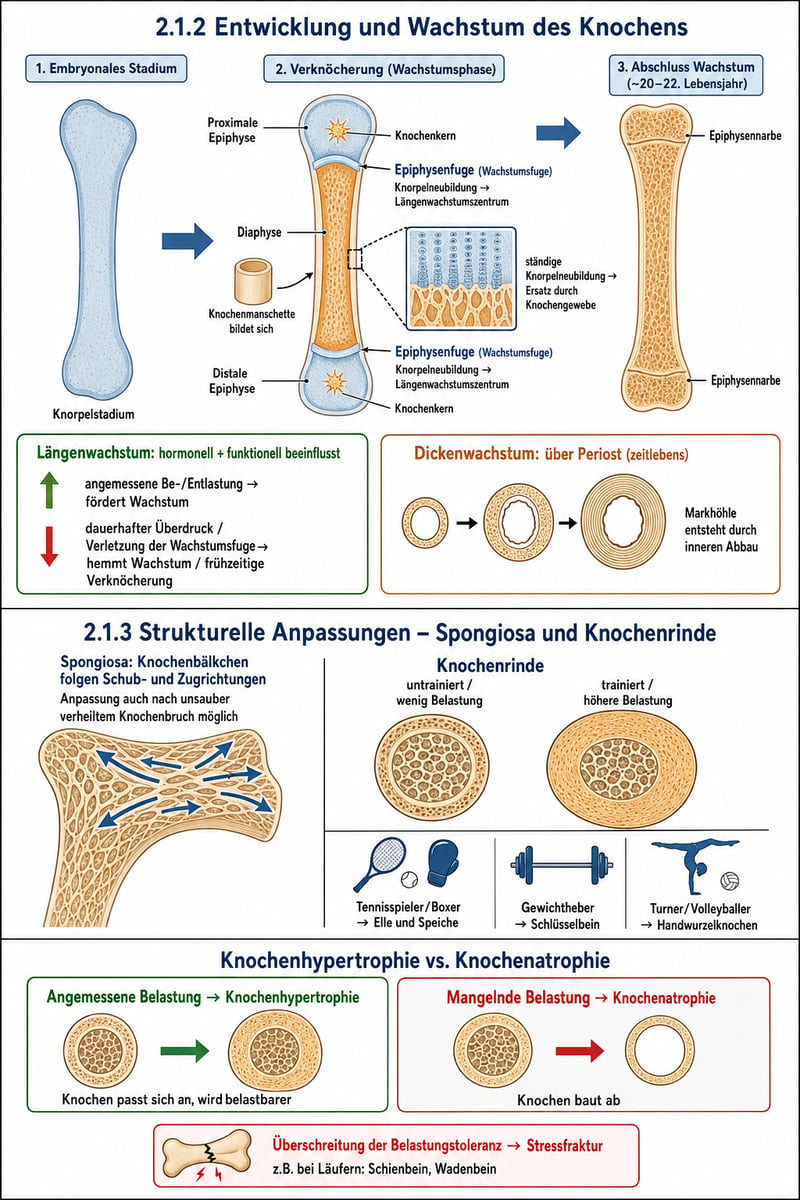
Diagramm zum Knochenwachstum und Anpassung

Create a clear, detailed educational diagram in the style of a modern anatomy textbook, explaining bone development, growth and structural adaptation ("Knochenwachstum und Knochenanpassung") for chapters 2.1.2 and 2.1.3, based exactly on the following source content (German labels must match these terms precisely). Overall layout: three clearly separated horizontal sections on one page. TOP SECTION — "2.1.2 Entwicklung und Wachstum des Knochens": A side-by-side sequence of three bone-growth stages shown as simplified long bone cross-sections, connected by right-pointing arrows: Stage 1 — "Embryonales Stadium": a fully cartilage-shaped bone outline (blue-grey fill), labeled "Knorpelstadium" Stage 2 — "Verknöcherung (Wachstumsphase)": same bone shape but now showing: - "Diaphyse" (central shaft, mostly bone/orange fill) with a small tube-collar icon labeled "Knochenmanschette bildet sich" - "Proximale Epiphyse" (top end, partly cartilage, partly bone) with a small starburst icon labeled "Knochenkern" - "Distale Epiphyse" (bottom end, same) with a small starburst icon labeled "Knochenkern" - A highlighted band between Diaphyse and each Epiphyse labeled "Epiphysenfuge (Wachstumsfuge)" with a small subtitle: "Knorpelneubildung → Längenwachstumszentrum" - A small zoomed callout arrow showing the Epiphysenfuge in close-up, labeled "ständige Knorpelneubildung → Ersatz durch Knochengewebe" Stage 3 — "Abschluss Wachstum (~20–22. Lebensjahr)": bone fully ossified, Epiphysenfuge replaced by a thin scar line labeled "Epiphysennarbe" Below the sequence, a small separate annotation panel: - "Längenwachstum: hormonell + funktionell beeinflusst" with two small arrows: "angemessene Be-/Entlastung → fördert Wachstum" (green up arrow) and "dauerhafter Überdruck / Verletzung der Wachstumsfuge → hemmt Wachstum / frühzeitige Verknöcherung" (red down arrow) - "Dickenwachstum: über Periost (zeitlebens)" with a small ring-growth icon showing layers building outward and a hollow center forming labeled "Markhöhle entsteht durch inneren Abbau" MIDDLE SECTION — "2.1.3 Strukturelle Anpassungen – Spongiosa und Knochenrinde": LEFT: a zoomed cross-section of spongy bone (Spongiosa) showing Knochenbälkchen aligned along directional force-arrows, labeled "Spongiosa: Knochenbälkchen folgen Schub- und Zugrichtungen" with subtitle "Anpassung auch nach unsauber verheiltem Knochenbruch möglich" RIGHT: a comparison of two bone cross-sections side by side showing the outer cortical ring: - Thin "Knochenrinde" ring labeled "untrainiert / wenig Belastung" - Thicker "Knochenrinde" ring labeled "trainiert / höhere Belastung" with three small sport icons: tennis racket (labeled "Tennisspieler/Boxer → Elle und Speiche"), barbell (labeled "Gewichtheber → Schlüsselbein"), gymnastics figure (labeled "Turner/Volleyballer → Handwurzelknochen") BOTTOM SECTION — "Knochenhypertrophie vs. Knochenatrophie": A simple two-sided diagram with a vertical dividing line: LEFT (green): "Angemessene Belastung → Knochenhypertrophie" — icon: a cross-section bone outline growing thicker — subtitle: "Knochen passt sich an, wird belastbarer" RIGHT (grey/red): "Mangelnde Belastung → Knochenatrophie" — icon: a cross-section bone outline shrinking thinner — subtitle: "Knochen baut ab" BELOW center: a small warning box labeled "Überschreitung der Belastungstoleranz → Stressfraktur" with a small cracked bone icon and subtitle: "z.B. bei Läufern: Schienbein, Wadenbein" Style: flat, clean vector design, color-coded (blue-grey for cartilage, orange/beige for bone, green for positive adaptation, red/grey for negative), bold German headings, smaller descriptive subtitles, white background, sans-serif typography, high contrast suitable for black-and-white printing, no photorealism, no unnecessary shadow effects, generous spacing between the three sections. IMPORTANT: All text inside the image must be in German, using exactly these terms (Knorpelstadium, Diaphyse, Epiphyse, Proximale Epiphyse, Distale Epiphyse, Knochenkern, Epiphysenfuge, Wachstumsfuge, Epiphysennarbe, Periost, Dickenwachstum, Markhöhle, Spongiosa, Knochenbälkchen, Knochenrinde, Knochenhypertrophie, Knochenatrophie, Stressfraktur) — do not invent alternate German wording, and do not translate these terms into English.