

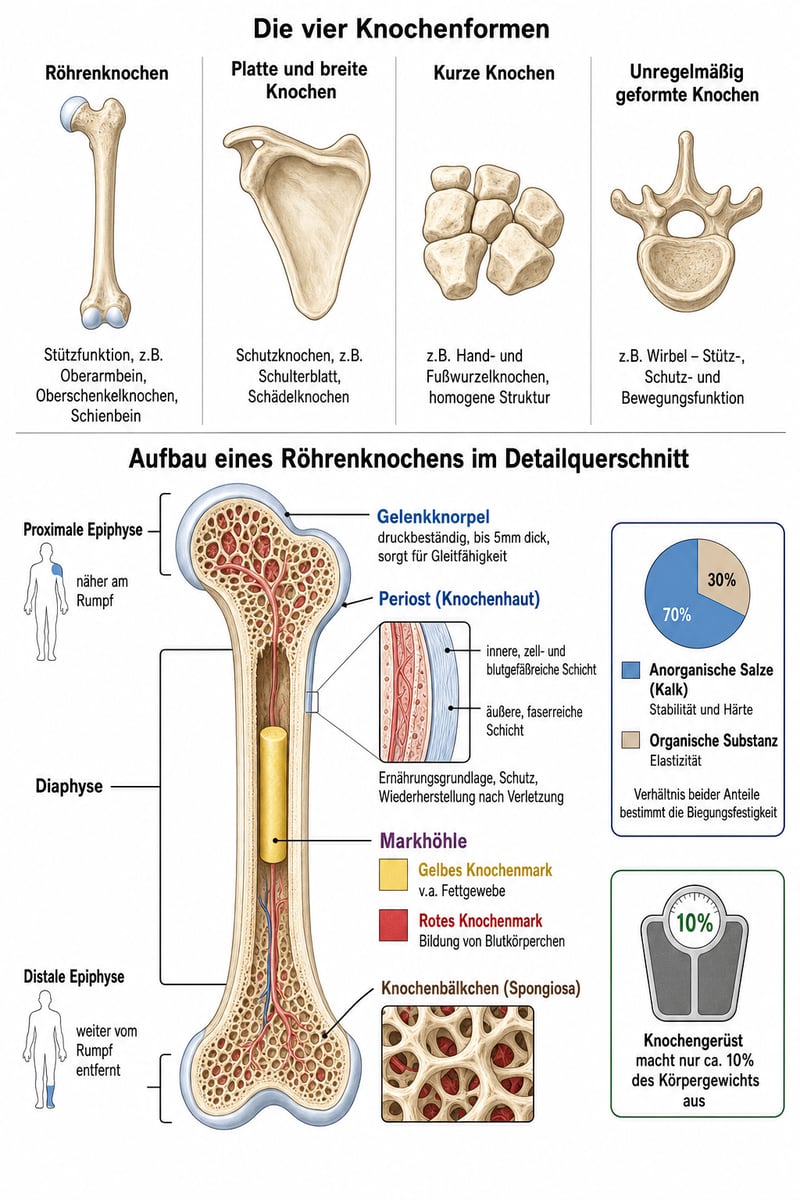
Detaillierte Knochenlehre Infografik

Create a clear, detailed educational diagram in the style of a modern anatomy textbook, explaining bone structure and bone types ("Knochenlehre"), based exactly on the following source content (German labels must match these terms precisely, do not paraphrase or translate them). Overall layout: split into two main parts on one page. TOP PART — "Die vier Knochenformen": four side-by-side labeled icons: - "Röhrenknochen" (long tubular bone, e.g. shaped like a thigh bone) — subtitle: "Stützfunktion, z.B. Oberarmbein, Oberschenkelknochen, Schienbein" - "Platte und breite Knochen" (flat wide bone shape, e.g. shoulder blade outline) — subtitle: "Schutzknochen, z.B. Schulterblatt, Schädelknochen" - "Kurze Knochen" (small cluster of compact block-like shapes) — subtitle: "z.B. Hand- und Fußwurzelknochen, homogene Struktur" - "Unregelmäßig geformte Knochen" (irregular vertebra-like shape) — subtitle: "z.B. Wirbel – Stütz-, Schutz- und Bewegungsfunktion" BOTTOM PART — "Aufbau eines Röhrenknochens im Detailquerschnitt": one large labeled cross-section of a long bone (like a femur) with clear arrows to: - "Diaphyse" (the long central shaft) - "Proximale Epiphyse" (the thickened end closer to the trunk, with a small body-silhouette icon showing "näher am Rumpf") - "Distale Epiphyse" (the thickened end farther from the trunk, with a small body-silhouette icon showing "weiter vom Rumpf entfernt") - "Periost (Knochenhaut)" (thin outer membrane wrapping the whole bone), shown as a zoomed-in detail callout with two distinguishable sub-layers labeled "innere, zell- und blutgefäßreiche Schicht" and "äußere, faserreiche Schicht" — subtitle: "Ernährungsgrundlage, Schutz, Wiederherstellung nach Verletzung" - "Gelenkknorpel" (bluish-white smooth coating shown on the joint surface at the end of the epiphysis) — subtitle: "druckbeständig, bis 5mm dick, sorgt für Gleitfähigkeit" - "Markhöhle" (the hollow inner cavity of the shaft) containing two distinct color-coded fill types side by side: - "Gelbes Knochenmark" (yellow fill) — subtitle: "v.a. Fettgewebe" - "Rotes Knochenmark" (red fill, shown inside the spongy bone trabeculae near the epiphysis) — subtitle: "Bildung von Blutkörperchen" - A small zoomed inset showing the spongy lattice structure inside flat/short bones, labeled "Knochenbälkchen (Spongiosa)" Side info box: a small pie-chart-style icon showing the chemical composition of bone, split into two labeled portions: "Anorganische Salze (Kalk)" — subtitle: "Stabilität und Härte" and "Organische Substanz" — subtitle: "Elastizität", with a small note: "Verhältnis beider Anteile bestimmt die Biegungsfestigkeit". Another small side note box with a body-weight icon: "Knochengerüst macht nur ca. 10% des Körpergewichts aus" (lightweight but stable construction). Style: flat, clean vector design, distinct consistent colors per structure (e.g. blue for Periost, bluish-white for Gelenkknorpel, yellow/red for Knochenmark types), bold German headings with smaller descriptive subtitles underneath, white background, sans-serif typography, high contrast suitable for educational/teaching material and black-and-white printing, no photorealism, no unnecessary shadow effects, generous spacing between the top overview and bottom detail cross-section — similar to a detailed multi-panel infographic from a German anatomy textbook. IMPORTANT: All text inside the image must be in German, using exactly these terms (Röhrenknochen, Platte und breite Knochen, Kurze Knochen, Unregelmäßig geformte Knochen, Diaphyse, Proximale Epiphyse, Distale Epiphyse, Periost, Gelenkknorpel, Markhöhle, Gelbes Knochenmark, Rotes Knochenmark, Knochenbälkchen, Spongiosa, Anorganische Salze, Organische Substanz) — do not invent alternate German wording, and do not translate these terms into English.