

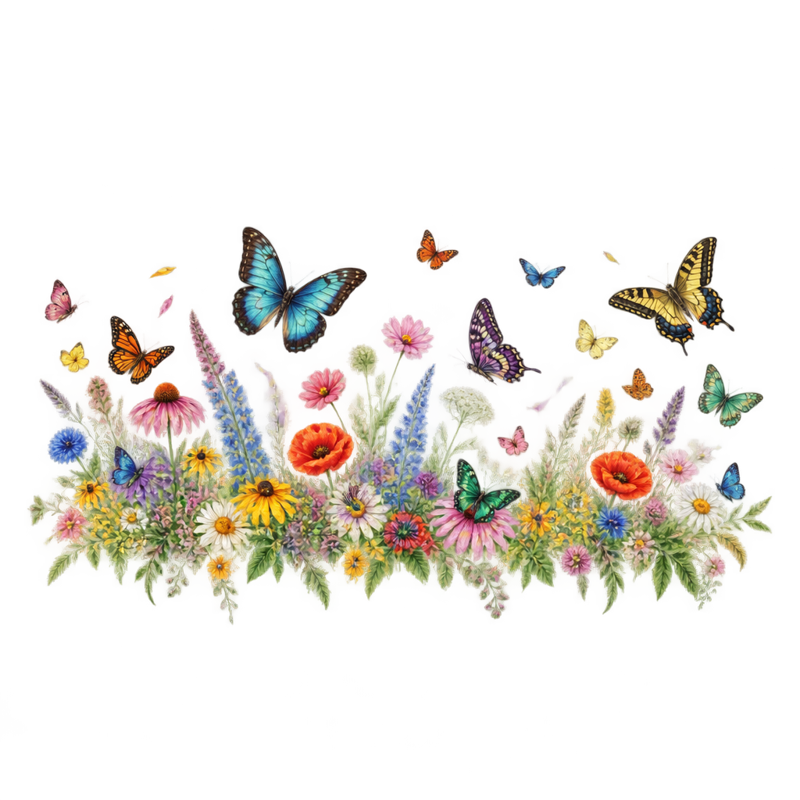
Vintage Multicolored Butterfly & Wildflowers

Create a beautifully detailed vintage-inspired multicolored butterfly and wildflower illustration with an elegant, airy composition and abundant pure white negative space surrounding the entire design. Feature a delightful variety of different colorful butterflies fluttering naturally above, between, and around a horizontal row of vibrant wildflowers. Position the main row of wildflowers approximately two-thirds of the way down the canvas, creating a graceful horizontal botanical band across the lower-middle portion of the image. Keep the flower row relatively narrow, loose, and contained rather than filling the entire bottom of the canvas. Vary the flower heights naturally, with taller blossoms and delicate stems rising above the main row and shorter flowers, leaves, and wispy grasses extending slightly below it. Fill the floral row with an abundant assortment of multicolored vintage wildflowers, including cosmos, daisies, poppies, asters, coneflowers, cornflowers, lavender, black-eyed Susans, delicate meadow blossoms, tiny wildflowers, unopened buds, and wispy grasses. Use a spectacular palette of hot pink, raspberry, fuchsia, coral, scarlet red, burnt orange, tangerine, golden yellow, sunny yellow, lavender, lilac, violet, deep purple, turquoise, cobalt blue, periwinkle, cream, and crisp white. Add lush but delicate foliage in emerald green, forest green, olive, sage, and deep blue-green. Keep the vegetation airy and natural, allowing small pockets of pure white to remain visible between flowers, leaves, and stems. Feature a beautiful assortment of various multicolored butterflies, with two or three larger butterflies prominently displayed above the flowers and several smaller butterflies loosely scattered throughout the scene. Include butterflies with wings in brilliant turquoise, sapphire blue, cobalt, violet, lavender, purple, fuchsia pink, coral, fiery orange, golden yellow, crimson red, emerald green, and combinations of multiple jewel-toned colors. Give each butterfly a different and distinctive wing pattern so the composition feels naturally diverse. Include blue and turquoise butterflies with dark wing borders, orange-and-black butterflies, purple-and-violet butterflies, yellow-and-black butterflies, pink-and-coral butterflies, and jewel-toned butterflies blending teal, blue, purple, and green. Avoid making all butterflies identical. Show the butterflies at different sizes, angles, heights, and natural poses. Include fully opened wings, three-quarter views, graceful side profiles, butterflies hovering above flowers, butterflies approaching blossoms, and a few gently resting upon colorful petals. Render the butterflies with realistic anatomy and intricate wing details, including delicate veins, natural wing markings, slender bodies, fine antennae, subtle dimensional shading, and luminous highlights. Add gentle iridescence to selected butterflies, allowing turquoise, violet, blue, and green wings to subtly shift color as they catch the light. Allow a few individual flowers, delicate stems, tiny blossoms, floating petals, and botanical sprigs to rise loosely above the horizontal flower row and mingle naturally with the butterflies. Scatter these elements irregularly rather than evenly, creating a whimsical sense of movement. Keep them sparse enough that the surrounding white space remains clearly visible. Give the entire artwork a beautiful vintage natural-history and botanical illustration aesthetic, combining realistic butterfly anatomy and botanical detail with subtle hand-painted character. Use painterly realism, delicate watercolor-inspired transitions, finely rendered flower petals, soft dimensional shading, subtle vintage print grain, gently weathered pigment, and slightly softened edges while keeping the colors bright, vibrant, and richly saturated. The composition should feel horizontal, graceful, loose, organic, and slightly asymmetrical, never like a wreath, bouquet, perfect circle, square, or full landscape. The flowers should clearly appear as a single loose horizontal row positioned approximately two-thirds down the image, while the colorful butterflies flutter primarily above, between, and around the flowers. White negative space is extremely important. Keep approximately 30–40% of the canvas around the outer perimeter completely empty pure white. Preserve an especially large expanse of uninterrupted white space across the upper portion of the canvas above the butterflies, along with generous pure white margins on the left, right, and bottom. Do not extend the wildflower row across the entire width of the canvas. Start and end the flowers well inside the left and right edges, leaving substantial blank white space on both sides. Every butterfly, flower, petal, leaf, stem, and blade of grass must remain completely visible and comfortably separated from the canvas perimeter. Vintage multicolored butterfly illustration, variety of colorful butterflies, unique butterfly wing patterns, turquoise, blue, purple, pink, orange, yellow, red and green butterflies, vibrant multicolored wildflowers, flowers arranged in a loose narrow horizontal row two-thirds down the canvas, butterflies fluttering above and amongst the flowers, jewel-toned colors, lush emerald-green foliage, vintage botanical realism, natural-history illustration, hand-painted details, vibrant saturated colors, subtle aged print texture, airy horizontal composition, enormous pure white negative space, extra-wide white margins, isolated artwork on pure white, no full-bleed scenery, no solid colored background, no rectangular landscape, no formal wreath, no border, no frame, no text, no typography, no logo, no watermark.